

Blog
What Is a GaN Charger and Why Is It Better?
Chargers have become smaller while handling more power, and what is a GaN charger and why is it better is a common question for smartphone, tablet, and laptop users. GaN chargers use gallium nitride instead of relying solely on traditional silicon-based power-switching components. The technology enables compact designs with high power density and efficient power conversion. For users, that can mean a smaller adapter, less wasted energy, and convenient high-wattage charging. This guide explains how GaN charging technology works, its practical benefits, differences from conventional chargers, common wattages, safety considerations, and how to choose the right GaN charger for your devices.
What Is a GaN Charger and Why Is It Better?
A GaN charger is a power adapter that uses gallium nitride semiconductor technology in its power-conversion circuitry. GaN components can switch electrical power efficiently at high frequencies, allowing charger manufacturers to create compact, high-power designs.
GaN stands for gallium nitride, a semiconductor material used in power electronics. Traditional chargers commonly use silicon-based components for switching and power conversion. GaN technology can provide advantages in switching performance and power density when properly designed.
The phrase “why are GaN chargers better” should not be interpreted as meaning every GaN charger automatically outperforms every conventional charger. Actual performance depends on the charger’s design, power rating, charging protocols, thermal management, components, and manufacturer.
How Does a GaN Charger Work?
A GaN charger converts electricity from an AC wall outlet into the controlled DC power required by a phone, tablet, laptop, or other device. GaN semiconductor components handle high-frequency switching within the power-conversion system.
Higher switching frequencies can allow designers to use smaller supporting components such as transformers and filtering components. Combined with efficient circuit design, this contributes to the compact size and high power density associated with modern GaN power adapters.
From a practical perspective, users don’t need to understand the electrical engineering behind the charger. The key point is that GaN charging technology helps manufacturers build smaller adapters capable of delivering substantial power.
Why Are GaN Chargers Better for Everyday Charging?
GaN chargers can offer a useful combination of compact size, high power density, efficient power conversion, and high-wattage output. These characteristics make them particularly useful for people who charge several devices or travel frequently.
A conventional high-power charger can require a relatively large enclosure and substantial thermal-management components. A well-designed GaN power adapter can deliver comparable power from a smaller form factor.
Smaller and More Portable
One of the most noticeable GaN charger benefits is size. A compact GaN charger can replace separate adapters for several devices, depending on its ports and total power output.
That makes GaN particularly practical for travel. Instead of carrying individual chargers for a smartphone, tablet, earbuds, and laptop, a suitable multi-port GaN charger may handle several of those devices from one adapter.
High Power Density
Power density refers broadly to how much power a device can handle relative to its physical size. GaN technology enables charger designers to build high-output adapters without necessarily making them proportionally larger.
A 65W GaN charger, for example, can provide enough output for many smartphones, tablets, and compatible laptops while remaining relatively compact.
Efficient Power Conversion
Efficient power conversion reduces energy lost as heat during operation. GaN components can support efficient switching, although the overall efficiency of a charger depends on its complete circuit design rather than the semiconductor material alone.
For this reason, an energy-efficient GaN charger should be evaluated as a complete product, not simply by the fact that it uses GaN.
High-Wattage Charging
GaN technology is particularly common in chargers offering higher power outputs such as 65W, 100W, and beyond. These chargers can support devices that require more power, including many USB-C laptops.
However, higher wattage doesn’t automatically make a device charge faster. The phone or laptop, charger, charging protocol, and cable all need to support the required power level.
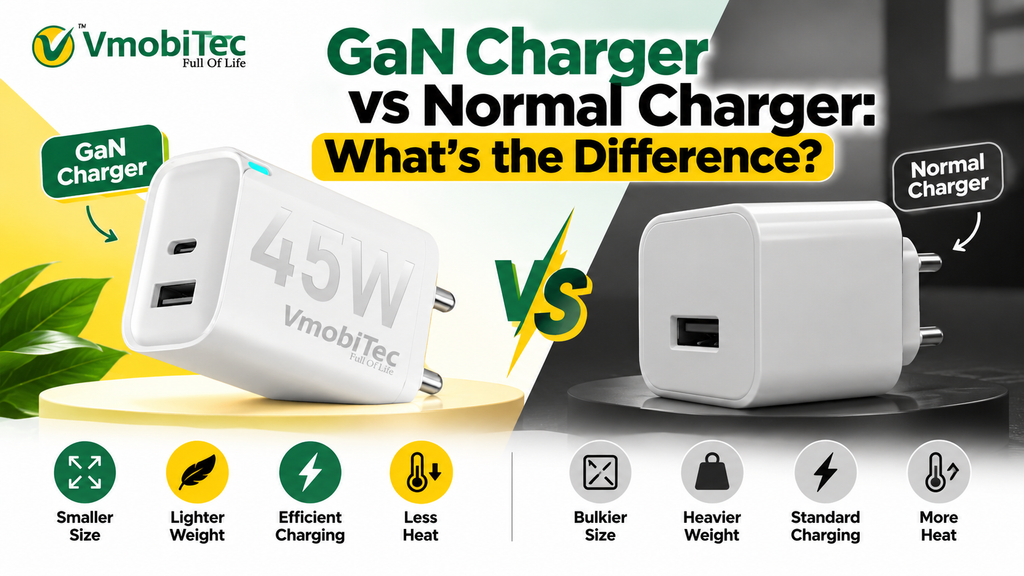
GaN Charger vs Normal Charger: What’s the Difference?
The main difference between a GaN charger and a traditional charger is the semiconductor technology used in the power-conversion circuitry and the resulting design possibilities. GaN technology can support compact, high-power charger designs, while conventional silicon-based designs remain widely used and can also provide excellent performance.
| Feature | GaN Charger | Traditional Charger |
|---|---|---|
| Semiconductor technology | Gallium nitride components may be used in power switching | Commonly silicon-based |
| Size | Often compact for its power rating | Varies; high-power models can be larger |
| Power density | Generally high | Depends on design |
| Heat management | Can support efficient designs | Depends on components and circuit design |
| High-wattage designs | Common | Also available |
| Multi-device models | Widely available | Widely available |
| Portability | Often excellent | Varies by model |
| Efficiency | Can be highly efficient | Depends on charger design |
The comparison shows why GaN charger vs regular charger isn’t simply about replacing an old charger with a newer technology. A quality traditional charger can still work very well. GaN becomes particularly useful when compactness, high output, and multi-device charging are priorities.
What Are the Different GaN Charger Wattages?
GaN chargers are available across a wide range of power ratings, including 20W, 30W, 45W, 65W, 100W, and higher outputs. The right wattage depends on the devices being charged and the charging standards they support.
VMobiTec GaN Chargers for Everyday Devices
VMobiTec offers GaN chargers designed for users who want a compact charging solution without giving up useful power output. Depending on the model, a VMobiTec GaN charger can be suitable for smartphones, tablets, laptops and other USB-C devices. When choosing between models, compare the wattage, number of ports, USB-C Power Delivery support and compatible charging cable. You can explore the available VMobiTec GaN chargers to find an option that matches your device and everyday charging requirements.
| GaN Charger | Smartphones | Tablets | Ultrabooks | Larger Laptops | Multi-Device Use |
|---|---|---|---|---|---|
| 20W | Excellent | Limited | Usually limited | Not suitable | Basic |
| 30W | Excellent | Good | Limited/varies | Usually limited | Basic |
| 45W | Excellent | Excellent | Suitable for some | Varies | Good |
| 65W | Excellent | Excellent | Suitable for many | Suitable for some | Good |
| 100W | Excellent | Excellent | Suitable | Suitable for many | Excellent |
| 140W+ | Excellent | Excellent | Suitable | Suitable for compatible models | Advanced |
These are general use categories, not universal compatibility rules. A laptop may require a specific USB-PD profile, while a smartphone may use a proprietary fast-charging system. Always check the manufacturer’s charging requirements.
Is a 65W GaN Charger Enough?
A 65W GaN fast charger is a practical option for users who want one adapter for a phone, tablet, and many compatible laptops. It can also provide useful headroom for multi-device charging, depending on how the ports divide available power.
For a single smartphone, 65W may exceed the phone’s maximum supported charging rate. The phone will normally negotiate an appropriate power level rather than automatically receiving the charger’s full rated output.
When Does a 100W GaN Charger Make Sense?
A 100W USB-C GaN charger is more suitable when laptop charging is part of the requirement. It can also be useful for users who want to charge multiple devices from one adapter.
The key consideration is power distribution. A 100W multi-port charger may have a 100W total rating but divide that power between ports when multiple devices are connected.
USB-C, USB PD and Fast-Charging Standards
USB-C describes a physical connector, while USB Power Delivery (USB PD) is a charging and power-negotiation protocol. A USB-C port does not automatically mean that a charger supports every USB-PD power level or fast-charging feature.
USB Power Delivery allows compatible devices and chargers to negotiate supported voltage and current levels. PPS, or Programmable Power Supply, provides more granular voltage adjustment and is supported by some modern charging systems.
Qualcomm Quick Charge is another fast-charging technology used by compatible devices. Apple devices can also support fast charging when paired with a compatible power adapter and cable.
For laptop charging, USB-C Power Delivery is particularly important. A GaN charger for laptops should therefore be evaluated by its USB-PD capabilities, output profiles, port configuration, and the laptop’s own requirements.
VMobiTec GaN Chargers for Everyday Charging
VMobiTec offers mobile and electronic accessories for customers in India, including chargers, charging cables, power banks, earbuds, smartwatches, and other everyday accessories. For shoppers comparing GaN charging options, VMobiTec can be positioned as an online destination for exploring affordable charging accessories based on device and power requirements.
When choosing a VMobiTec charger, check the listed wattage, available ports, USB-C compatibility, supported charging protocols, cable requirements, and safety features. A charger should always be selected according to the device’s supported charging specifications rather than wattage alone.
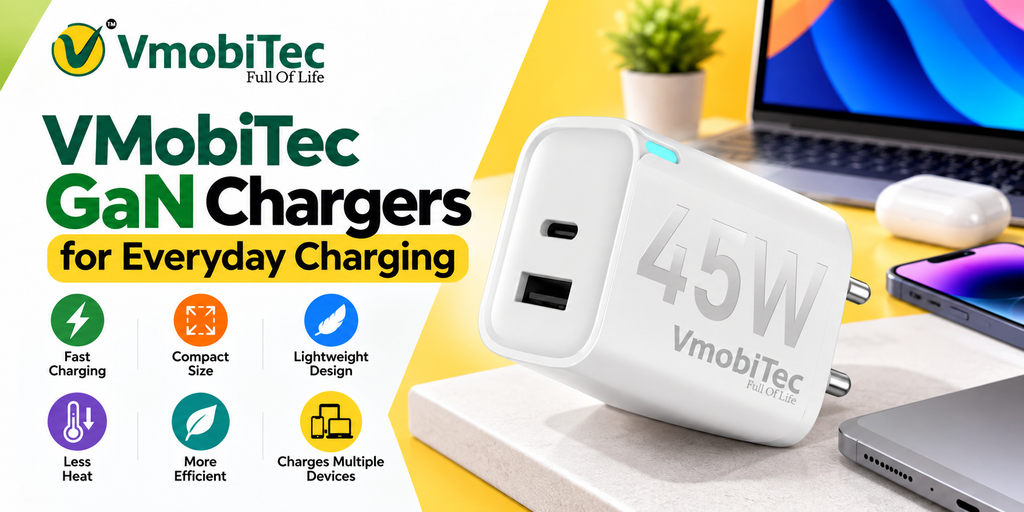
For users who need a VMobiTec fast charger for smartphones, tablets, or other compatible devices, comparing output ratings and port configurations can help identify the appropriate option. Users charging several devices may also consider a multi-port charger to reduce the number of adapters needed.
Choosing the Right VMobiTec Charging Accessories
VMobiTec provides a range of VMobiTec charging accessories, making it possible to compare chargers and cables for different everyday charging requirements. A suitable combination of charger and cable can help ensure that a compatible device receives the intended charging power.
For smartphone users, a VMobiTec phone charger can be selected according to the phone’s supported charging speed and connector. Users should also check whether their device requires USB-C Power Delivery, PPS, or another charging technology.
A VMobiTec charging cable should likewise be matched to the connector and power requirements of the device. For higher-power USB-C charging, cable capability matters because the cable forms part of the complete charging system.
Explore GaN Charging Options from VMobiTec
VMobiTec offers a range of mobile chargers and charging accessories for smartphone, tablet and other everyday device users in India. If you’re comparing a GaN charger, look at important factors such as wattage, USB-C Power Delivery support, number of ports, cable compatibility and safety protections rather than choosing based on wattage alone. VMobiTec also provides charging cables, chargers and other mobile accessories, giving users multiple options for building a reliable charging setup for home, office or travel.
For customers in India, VMobiTec operates as an online store serving mobile and electronic accessory requirements. The product range includes chargers, charging cables, power banks, earbuds, smartwatches, and other accessories.
What Are the Benefits of GaN Chargers?
The main benefits of GaN chargers are compact size, high power density, efficient power conversion, and the ability to deliver substantial power from relatively small adapters.
- Compact design: GaN technology can help manufacturers create smaller high-power adapters.
- High power density: More power can be delivered from a relatively compact enclosure.
- Convenient travel: A single compact adapter can potentially replace several separate chargers.
- High-wattage support: Many GaN models are available at 65W, 100W, and higher ratings.
- Multi-device charging: Multi-port models can charge phones, tablets, earbuds, and laptops from one adapter.
- Efficient operation: Well-designed GaN chargers can achieve efficient power conversion and manage heat effectively.
- Modern USB-C support: Many GaN adapters include USB-C PD for compatible phones, tablets, and laptops.
- Reduced charger clutter: One suitable adapter can simplify a desk or travel charging setup.
How Do Multi-Port GaN Chargers Work?
A multi-port GaN charger uses a shared power system to distribute available output among two or more charging ports. The total advertised wattage does not necessarily mean every port can deliver that amount simultaneously.
For example, a 100W multi-port GaN charger might provide its highest output through one USB-C port. Connecting a second device can change the available power allocation between the ports.
Before buying a GaN charger for multiple devices, check the manufacturer’s power-distribution table. This is especially important if you plan to charge a laptop and smartphone at the same time.
USB-C and USB-A Configurations
A modern charger may combine multiple USB-C ports with USB-A. USB-C is generally preferred for newer devices and USB-PD charging, while USB-A remains useful for older cables and accessories.
A USB-C USB-A dual-port charger can therefore be useful for mixed-device households where both newer and older charging cables are still in use.
Is a GaN Charger Safe?
GaN technology itself does not guarantee charger safety. Safety depends on the complete charger design, component quality, thermal management, electrical protections, manufacturing quality, and applicable certification requirements.
A quality GaN charger should include appropriate protections such as:
- Over-voltage protection
- Over-current protection
- Over-temperature protection
- Short-circuit protection
- Power regulation
- Appropriate thermal management
A GaN charger safety assessment should also consider the manufacturer, warranty, product documentation, and applicable certification or compliance information.
Avoid choosing a charger solely because it has a high wattage or a low price. A properly designed 30W charger can be a better fit for a smartphone than an unnecessarily high-powered adapter from an unreliable source.
How to Choose the Best GaN Charger
The best GaN charger is the one that matches your devices, required wattage, charging protocols, port requirements, and intended use. Start with your devices rather than choosing the highest wattage available.
1. Check Required Wattage
Identify the maximum charging power supported by your phone, tablet, or laptop. A 20W or 30W model may be sufficient for many phones, while laptops may require 45W, 65W, 100W, or more.
2. Check USB-PD and PPS Support
If your devices rely on USB-PD or PPS, verify that the charger supports the required standard and power profiles.
3. Consider the Number of Ports
A single-port charger is straightforward for one device. A dual-port or multi-port GaN charger makes more sense when you regularly charge several devices.
4. Check Power Sharing
For multi-port models, examine how power is divided when two or more devices are connected. This can be more important than the headline total wattage.
5. Match the Cable
The charger and device can only operate within the capabilities of the connected cable and charging system. High-power USB-C charging may require a cable rated for the required power.
6. Consider Size and Travel Needs
A compact GaN charger for travel can reduce the amount of equipment in your bag. Look at the charger’s dimensions, weight, plug design, and port arrangement.
7. Evaluate Safety and Warranty
Look for appropriate protections, clear specifications, reliable manufacturing information, and warranty or after-sales support.
8. Compare Price With Specifications
GaN charger price varies according to wattage, port count, charging protocols, build quality, and brand. An affordable GaN charger can be a good choice when its specifications match your actual requirements.
GaN Charger for Phones, Laptops and Multiple Devices
A GaN charger can work with smartphones, tablets, laptops, earbuds, smartwatches, and other compatible USB-powered devices when the charger’s output and charging protocol match the device requirements.
For smartphones, a compact 20W–45W charger may be enough depending on the model. A 65W model provides additional capacity and can be useful when the same adapter is also used for a tablet or compatible laptop.
For laptops, pay close attention to USB-PD output. A GaN charger for MacBook and laptop should be selected according to the computer’s recommended charging power rather than simply choosing the largest number printed on the charger.
For multiple devices, a multi-port model can simplify charging at home, in the office, or while travelling.
Are GaN Chargers Worth Buying?
GaN chargers can be worthwhile when you value compact size, high power output, modern USB-C charging, or the ability to replace several adapters with one charger. They are especially useful for people who carry multiple devices.
A traditional charger may still be perfectly adequate if you only need basic charging for one device. GaN becomes more compelling when you want a compact high-power adapter or a single charger capable of handling several compatible devices.
The technology should therefore be viewed as a design advantage, not a guarantee of superior performance in every product.
Frequently Asked Questions About What Is a GaN Charger and Why Is It Better
Q: What is a GaN charger and why is it better?
A: A GaN charger uses gallium nitride semiconductor technology in its power-conversion circuitry. GaN can support high-frequency switching and compact power designs, allowing manufacturers to build small chargers with substantial power output. The practical advantages can include portability, high power density, efficient operation, and convenient multi-device charging.
Q: Is a GaN charger better than a normal charger?
A: A GaN charger can be better suited to users who want a compact, high-power adapter, but it isn’t automatically better in every situation. Traditional chargers can also provide reliable charging. Compare wattage, USB-PD support, ports, safety protections, efficiency, size, and build quality before choosing between the two technologies.
Q: Is a GaN charger safe for phones?
A: Yes, a properly designed GaN charger can safely charge compatible phones. The charger and phone negotiate an appropriate power level when supported charging protocols are used. Safety depends on the complete charger design, including over-voltage, over-current, temperature, and short-circuit protections, rather than GaN technology alone.
Q: Does a GaN charger charge faster?
A: GaN technology can enable chargers with high power output, but GaN itself doesn’t guarantee faster charging. Actual charging speed depends on the phone or laptop, charger wattage, charging protocol, cable, battery-management system, and temperature. A device only draws the power it is designed and configured to accept.
Q: Is a 65W GaN charger enough for a laptop?
A: A 65W GaN charger is suitable for many compatible laptops, particularly lower-power and ultraportable models. However, requirements vary between computers. Check the laptop manufacturer’s recommended charging power and USB-PD requirements before buying. Some larger performance laptops may require substantially more power.
Q: What is the difference between a GaN charger and a normal charger?
A: The primary difference is the semiconductor technology used in the charger’s power-conversion circuitry. GaN chargers use gallium nitride components that can support efficient, high-frequency switching and compact designs. Traditional chargers commonly use silicon-based components. Actual size, efficiency, heat, and charging performance depend on the complete circuit design.
Q: Are GaN chargers worth buying?
A: GaN chargers can be a practical upgrade for users who need high power in a compact package. They are particularly useful for travel, laptop charging, and multi-device setups. If your current charger already meets your needs and portability isn’t a concern, there may be less reason to replace it solely for the technology.
Q: Can a GaN charger charge multiple devices?
A: Yes, many GaN chargers have two, three, or more ports and can charge multiple compatible devices simultaneously. However, available power is usually shared between ports. Before buying, check the manufacturer’s power-allocation specifications to ensure the charger can provide enough power to your laptop, phone, tablet, or accessories at the same time.
A GaN charger can work with modern charging standards such as USB Power Delivery (USB PD), but GaN and USB PD are different technologies. GaN refers to the semiconductor material used in the charger’s power circuitry, while USB PD is a power-negotiation standard that determines how compatible devices and chargers communicate about available power. For the official technical information, readers can refer to the USB-IF USB Power Delivery specifications.
Final Takeaway From what is a GaN charger and why is it better
Understanding what is a GaN charger and why is it better comes down to the combination of semiconductor technology, power density, efficiency, size, and charging capability. GaN is particularly useful when you want a compact adapter with enough power for modern smartphones, tablets, laptops, or multiple devices. When choosing a charger, match wattage, USB-PD/PPS support, ports, cable capability, safety protections, and price to your actual requirements.