
Blog
Best Car Charger Fast Charging in India 2026

amazon link : https://www.amazon.in/Vmobitec-Charger-VCR-3000-Charging-Technology/dp/B0GY1NYHKG
Car Charger Fast Charging: The Complete India Buying Guide (2026)
Your phone losing charge on a long drive is no longer just inconvenient — it’s a real problem. Whether you’re navigating through Hyderabad’s outer ring road or doing back-to-back client visits in Delhi, a car charger fast charging setup can fully top up your device in the time it takes to get from one end of the city to the other.
This guide covers everything you need: how fast charging protocols work, which wattage actually matters, which phones support what standards, and what to avoid when buying a fast car charger in India. No guesswork — just the facts that help you make the right purchase.
What Is a Car Charger Fast Charging and How Does It Work?
A car charger with fast charging is a 12V DC-powered adapter that uses intelligent voltage and current negotiation to charge your smartphone dramatically faster than a basic 5W charger.
Standard car chargers — the ones bundled with older accessories — deliver a flat 5W (5V at 1A). A fast charging car charger using modern protocols like USB Power Delivery (PD) or Qualcomm Quick Charge (QC) can push 18W, 30W, 45W, or 65W through the same cigarette lighter port, cutting charge times by 60–75%.
The magic happens in the handshake. When you plug in, the charger and your phone exchange data — the phone tells the charger the maximum voltage and current it can safely accept, and the charger adjusts accordingly. This is why a 45W car charger won’t damage an 18W phone. The phone takes only what it needs.
For Indian commuters averaging 45–90 minutes in metro city traffic, this handshake — and the right charger behind it — is the difference between arriving at a meeting with 60% battery or 15%.
Qualcomm Quick Charge — The Android Standard
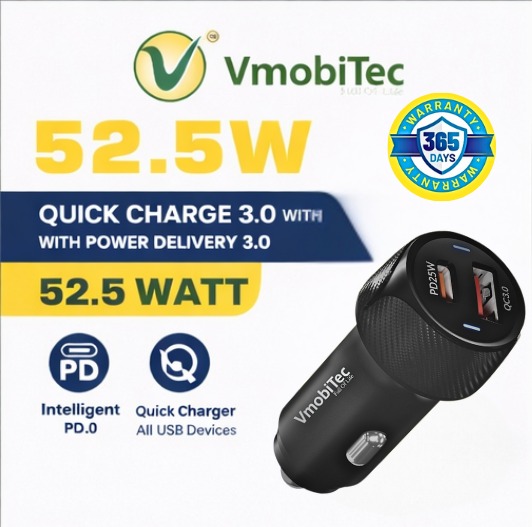
Qualcomm Quick Charge (QC) is the most widely used fast charging protocol in Android phones sold in India. QC 3.0 car chargers deliver up to 18W, while QC 4.0 pushes up to 27W. Phones from Xiaomi, Redmi, Realme, Samsung, and OnePlus all support QC to varying degrees.
QC works over USB-A ports and uses adaptive voltage technology — adjusting between 3.6V and 20V to find the optimal charging point for your battery level. The result is faster charging with less heat, which is critical in Indian summer temperatures where car interiors can reach 50°C+.
USB Power Delivery — The Universal Fast Charging Standard
USB Power Delivery (PD) is the universal fast charging standard supported by iPhones, Google Pixel, Samsung Galaxy S-series, and virtually every flagship Android released after 2020.
PD exclusively uses USB-C ports and supports output ranging from 18W up to 100W depending on the charger. Apple officially recommends a minimum 20W PD charger for fast charging iPhone 12 and above. iPhone 15 users should note that the new USB-C direct port makes PD even more seamless.
The key advantage of PD over QC is cross-brand compatibility. A single USB-C PD car charger can fast charge an iPhone, a Samsung Galaxy S24, and a Google Pixel 8 — all using the same port and cable.
Types of Fast Car Chargers Available in India
Choosing the wrong type of car charger is one of the most common and expensive mistakes Indian buyers make. Knowing the four main types before you buy saves money and guarantees you get the charging speed your phone is capable of.
Single Port USB-C PD Car Charger
A single port USB-C PD car charger routes all available wattage to one device, giving you the maximum possible speed. This is the right choice if you charge only your own phone and want clean, compact design without extra bulk.
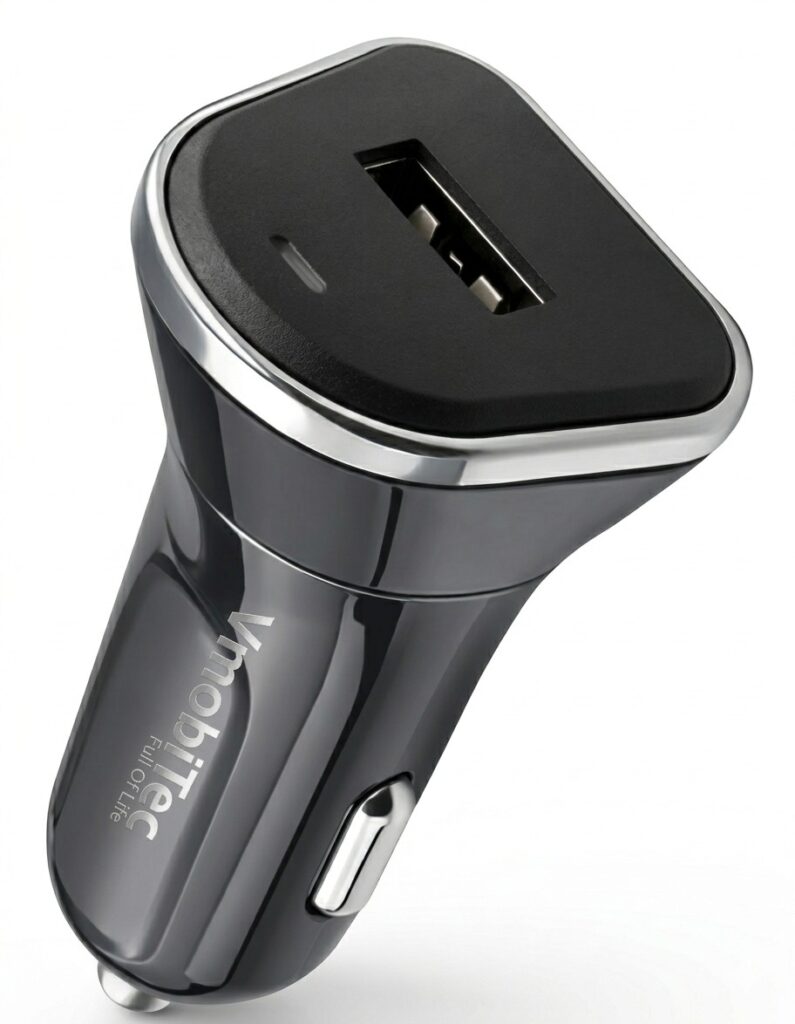
Most 30W and 45W single-port car chargers in India fall in the ₹499–₹999 range. They’re compact, lightweight, and sit flush in the socket — no protruding bulk that catches on car interiors.
Dual Port Car Charger (USB-C + USB-A)
A dual port car charger combines a USB-C PD port and a USB-A QC port, making it the most practical option for households where one person uses an iPhone and another uses an Android, or when you need to charge your phone and a Bluetooth speaker simultaneously.
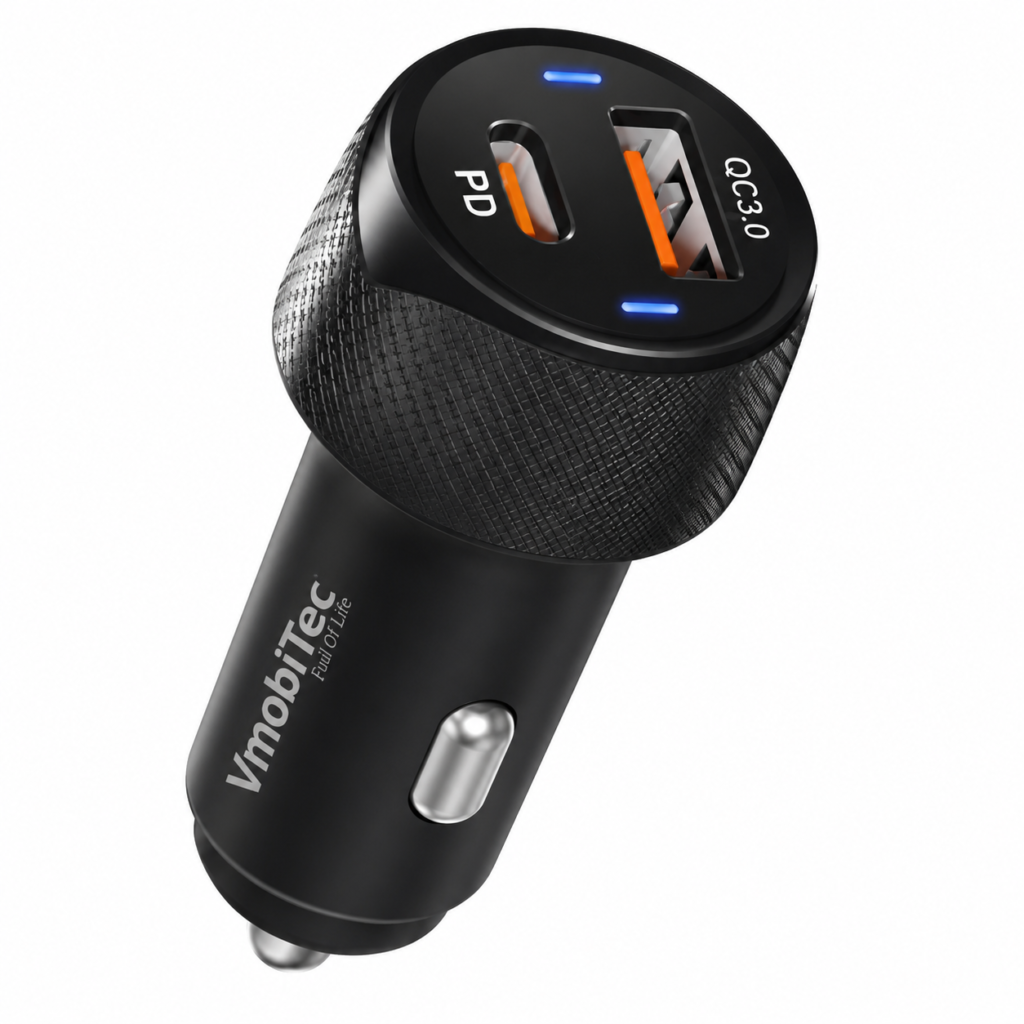
Pay attention to the spec sheet here. A “45W dual charger” typically means 30W on the USB-C side and 15W on the USB-A side when both are active. Total wattage is shared — not duplicated.
GaN Fast Car Charger
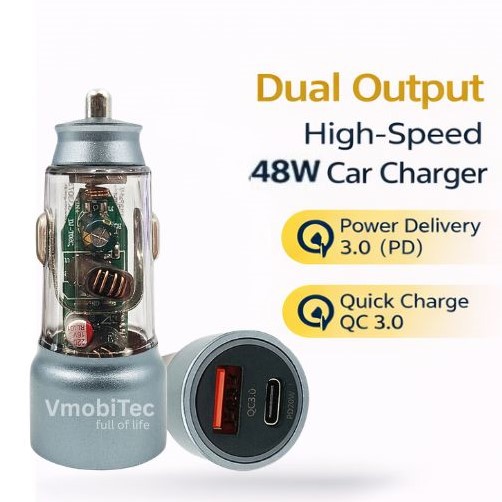
GaN (Gallium Nitride) car chargers represent a genuine upgrade in charging technology, not just marketing language. GaN semiconductors are more efficient than traditional silicon, meaning the charger produces less heat at the same wattage and achieves full output in a noticeably smaller body.
If you regularly park in direct sunlight or drive in hot cities like Chennai, Hyderabad, or Pune, a GaN car charger fast charging setup is worth the price premium — typically ₹299–₹500 more than standard models.
How to Choose the Right Car Charger Fast Charging for Your Phone
Matching your car charger to your specific phone’s capabilities is the single most important step in getting true fast charging speeds. Here’s a straightforward process:
Step 1 — Find your phone’s maximum supported wattage. Go to your manufacturer’s official spec page. iPhone 15 Pro: 27W PD. Samsung Galaxy S24: 45W PD. OnePlus 12: 80W (SUPERVOOC). Xiaomi 14: 67W HyperCharge. Note: proprietary protocols like SUPERVOOC and HyperCharge may not reach full speed through third-party car chargers, but they’ll still fast charge at QC or PD speeds.
Step 2 — Match the charging port type.
- iPhone → USB-C PD only
- Samsung Galaxy S/A → USB-C PD or QC 3.0
- Xiaomi, Realme, Oppo → QC 3.0 (proprietary max speeds may not apply)
- Older Androids with micro-USB → QC 2.0 or AFC via USB-A
Step 3 — Decide how many devices you charge at once. If it’s just you, buy a single-port charger at full wattage. If the car is shared, a dual port fast car charger with both PD and QC is the practical answer.
Step 4 — Verify safety certifications. In India, look for BIS (Bureau of Indian Standards) certification on the product page or packaging. Also check for CE marking and built-in protections: overvoltage, overcurrent, overheat, and short circuit. These aren’t optional — they’re essential.
Step 5 — Check the cable, not just the charger. Your fast car charger can only deliver full speed if your cable supports it. A USB-C cable rated for 5A/100W unlocks full PD speeds. A cheap ₹50 cable limits you to 3A regardless of charger wattage.
Wattage Comparison — Which Fast Car Charger Suits Your Phone?
The right wattage depends on your phone model, not on which number sounds fastest. Buying more wattage than your phone supports wastes money but causes no harm. Buying too little means leaving speed on the table.
| Wattage | Protocol | Charging Speed (0–50%) | Best Phone Match | Price Range India |
|---|---|---|---|---|
| 18W | QC 3.0 | ~35 minutes | Xiaomi, Redmi, Realme, Samsung A-series | ₹299–₹599 |
| 20W | PD 3.0 | ~30 minutes | iPhone 12, 13, 14 | ₹349–₹699 |
| 30W | PD / QC | ~25 minutes | Samsung Galaxy S22, OnePlus Nord | ₹499–₹999 |
| 45W | PD 3.0 | ~18–20 minutes | Samsung S23/S24, Google Pixel 8, iPhone 15 Pro | ₹699–₹1,299 |
| 65W (GaN) | PD 3.1 | ~13–15 minutes | Flagship phones, iPads, compact laptops | ₹999–₹1,999 |
For the majority of Indian smartphone users in 2026, a 30W or 45W USB-C car charger fast charging unit hits the ideal price-to-performance ratio. It’s powerful enough for current flagships and remains compatible as you upgrade.
Wattage Mistakes to Avoid
Buying a 65W charger for a phone capped at 18W delivers zero extra speed — the phone’s power management chip simply refuses to draw more than it can handle. Spend the extra money on a better cable instead.
Equally, a “45W dual port” car charger drops to roughly 18W per port when both slots are in use. If your Samsung Galaxy S24 needs 45W for peak performance, plugging a second device in simultaneously means neither device gets optimal speed.
Common Mistakes and Expert Tips for Car Charger Fast Charging
Getting fast charging right in a car involves more than just picking the right adapter. Most people unknowingly cut their charging speed in half through avoidable errors.
The Four Most Expensive Mistakes
1. Using a non-certified cable. The cable is the bottleneck. A thin, unmarked USB-C cable limits current to 1–2A regardless of what the charger supports. Always use a cable rated for 3A minimum for PD fast charging.
2. Buying an uncertified charger. Cheap, unbranded car chargers from marketplace listings often lack proper safety circuits. A ₹99 charger without overvoltage protection can damage the phone battery slowly over months — or instantly in a single voltage spike.
3. Assuming proprietary protocols work universally. Realme SuperDart, Oppo SUPERVOOC, and Xiaomi HyperCharge are proprietary. These protocols work at full speed only with the brand’s own chargers and cables. Through a third-party car charger, you’ll get QC or PD speeds — still fast, but not peak speed.
4. Ignoring heat. Car interiors in Indian summers regularly exceed 45°C. Most smartphones throttle fast charging when the device temperature crosses 38–40°C. Park in shade, use a phone holder that doesn’t trap heat, and consider a GaN charger which runs cooler than traditional alternatives.
Expert Tip: Enable airplane mode during the first 20 minutes of charging. With radios off, your phone stops consuming power from the battery while charging — net charge rate increases by 20–30% in real-world conditions, regardless of charger wattage.
Expert Tip: Plug in at 20%, not at 1%. Most phone firmware deliberately restricts fast charging speeds when the battery is critically low (below 5%). You’ll see faster overall results by plugging in before the battery gets critical.
Frequently Asked Questions About Car Charger Fast Charging
Q: What is the best car charger for fast charging in India in 2026?
A: The best car charger fast charging options in India support USB Power Delivery 3.0 or Qualcomm Quick Charge 3.0/4.0. A 30W–45W USB-C PD car charger covers most modern phones — including iPhones, Samsung Galaxy S/A series, and OnePlus. VmobiTec offers BIS-certified options across this wattage range.
Q: Is a 45W car charger safe for my phone?
A: Yes. A certified 45W fast car charger is completely safe. Your phone’s power management chip negotiates the voltage and current during charging — it will never draw more than it can safely handle. The charger offers capacity; the phone decides how much to accept.
Q: Can I use a car charger fast charging unit for iPhone?
A: Yes. iPhone 8 and above support USB Power Delivery. Use a USB-C PD car charger at 20W or above with a USB-C to Lightning cable (iPhone 8–14) or a USB-C to USB-C cable (iPhone 15 and above). A 20W PD car charger will charge iPhone 12–14 from 0 to 50% in approximately 30 minutes.
Q: Does fast charging in a car damage the car battery?
A: No, when the engine is running. A car charger fast charging at 45W draws approximately 3.75A from the 12V socket — well within what a running alternator provides. Charging with the engine off for extended periods is the only scenario that can stress the car’s 12V battery.
Q: What is the difference between Quick Charge and Power Delivery?
A: Quick Charge (QC) is Qualcomm’s proprietary protocol for USB-A ports, common in Android devices. Power Delivery (PD) is the universal USB standard for USB-C ports, supported by iPhones and Android flagships alike. PD supports higher peak wattage and is now the industry-preferred standard for any new device purchase.
Q: Which fast car charger works best for Samsung Galaxy phones?
A: Samsung Galaxy S-series phones support 45W PD natively. A 45W USB-C PD car charger delivers peak speed. For the Galaxy A-series (A54, A35), a 25W PD or 18W QC charger is sufficient and keeps costs reasonable.
Q: Do dual port car chargers split power when both ports are used?
A: Yes. A dual port fast car charger rated at 45W total typically delivers 30W on USB-C and 15W on USB-A when both are active. If maximum speed for your flagship phone matters, use the USB-C port alone to get full rated wattage.
Q: What cable do I need for a car charger fast charging setup?
A: For USB-C PD, use a cable rated for 3A/60W minimum (5A/100W for 45W+ chargers). Your phone’s original USB-C cable is the safest choice. For QC 3.0 over USB-A, any standard USB-A to USB-C or micro-USB cable works — the QC negotiation happens through the data pins.
Final Verdict: Getting Your Car Charger Fast Charging Right
Picking the right car charger fast charging setup isn’t complicated once you know the three numbers that matter: your phone’s max wattage, the protocol it supports, and how many devices you charge simultaneously.
For most Indian buyers in 2026 — a 30W USB-C PD dual-port car charger covers the overwhelming majority of use cases at a price point that makes sense. Step up to 45W if you own a Samsung Galaxy S-series or an iPhone 15 Pro. Add GaN technology if heat is a concern in your city or climate.
VmobiTec’s range of fast charging car chargers is BIS-certified, protocol-matched, and designed for the real conditions of Indian roads. Browse the full collection at vmobitec.com and stop settling for slow.
