Blog

How to Increase Power Bank Life: Best Tips to Extend Battery Performance
A power bank is useful when your smartphone battery runs low during travel, work, college, or daily activities. However, frequent charging, excessive heat, poor storage, and damaged cables can affect its performance over time. Learning how to increase power bank life helps you maintain reliable charging, reduce avoidable battery wear, and get better value from your purchase.
Most modern power banks use rechargeable lithium-ion or lithium-polymer batteries. These batteries naturally lose some capacity as they age, but good maintenance habits can help prevent unnecessary damage. From following the right power bank charging tips to storing your device correctly, a few simple practices can make a difference.
This guide explains how to extend power bank battery life, prevent overheating, identify common problems, and maintain your power bank for daily use.
What Does Power Bank Lifespan Mean?c
Power bank lifespan refers to how long a power bank remains useful before its battery capacity, charging performance, or overall condition declines significantly. Its lifespan depends on battery quality, charging habits, temperature, usage frequency, storage conditions, and the manufacturer’s design.
A power bank does not necessarily stop working when its battery begins to age. Instead, it may hold less charge, deliver fewer phone recharges, or take longer to charge itself.
Three factors affect power bank lifespan:
- Battery ageing: Rechargeable batteries gradually lose their ability to store energy.
- Usage patterns: Frequent charging and discharging contribute to normal battery wear.
- Environmental conditions: Excessive heat, moisture, physical damage, and unsuitable storage can shorten useful life.
There is no single lifespan that applies to every power bank. Battery capacity, quality, usage, and care all influence how long a particular model performs well.
How to Increase Power Bank Life With Proper Charging Tips
The best way to increase power bank life is to follow the manufacturer’s charging instructions, use compatible charging accessories, and avoid unnecessary heat. Consistent charging habits can help protect the battery and reduce avoidable wear.
1. Use a Compatible Charger and Cable
Choose a good-quality charger and cable that match your power bank’s input specifications. Check the voltage, current, connector type, and supported charging protocol in the manufacturer’s instructions.
An unsuitable or damaged charger can cause charging problems and excessive heat. A compatible fast charger may be appropriate if the power bank supports its charging standard; higher wattage alone does not guarantee faster or safer charging.
2. Avoid Excessive Heat During Charging
Heat is one of the main environmental factors that can accelerate lithium-ion battery ageing. Charge your power bank on a hard, stable, non-flammable surface in a well-ventilated area.
Avoid charging it under pillows, on beds, inside tightly packed bags, or in direct sunlight. Disconnect the device and allow it to cool if it becomes unusually hot.
3. Disconnect After Charging Is Complete
Follow the manufacturer’s instructions and disconnect the power bank when charging is complete. Avoid leaving it connected to a power source unnecessarily for long periods.
Many modern power banks include charging protection, but built-in protection does not eliminate every risk. Monitor charging, especially when using an unfamiliar charger or cable.
4. Avoid Deep Discharging as a Routine
You do not need to drain a power bank completely before recharging it. Recharge it when convenient, rather than repeatedly allowing it to reach zero.
Lithium-based batteries generally do not require the full discharge-and-recharge routine associated with some older battery technologies. Repeatedly leaving a power bank fully discharged for extended periods is also undesirable.
5. Check the Charging Cable Regularly
Inspect charging cables and connectors for fraying, bent pins, loose connections, or other visible damage. A faulty cable may interrupt charging, increase resistance, or cause excessive heat.
Replace damaged cables with compatible, good-quality alternatives. Handle connectors carefully instead of pulling a cable out by its wire.
Power Bank Battery Maintenance Tips for Everyday Use
Good power bank battery maintenance involves protecting the device from physical damage, using it within its rated limits, and keeping its ports clean and dry. These habits help maintain charging reliability and reduce preventable problems.
6. Keep Your Power Bank Away From Extreme Temperatures
Avoid exposing your power bank to direct sunlight, hot dashboards, parked cars, heaters, or other sources of intense heat. Very cold conditions can also affect battery performance.
In India, particular care is needed during summer travel. Do not leave a power bank inside a parked car, where temperatures can rise significantly.
7. Protect the Power Bank From Drops and Moisture
A power bank may look sturdy, but a hard fall can damage internal components or its battery. Keep it in a protective pouch when carrying it in a backpack or handbag.
Keep the device away from water, damp surfaces, and excessive humidity unless the manufacturer specifically states that it has suitable protection. Never charge a wet or visibly damaged power bank.
8. Keep Charging Ports Clean
Dust and debris can interfere with the connection between a charging cable and the power bank. Inspect the ports occasionally and keep the exterior clean with a soft, dry cloth.
Do not insert metal objects into the ports or use liquids and harsh cleaning chemicals. If a connector is loose, corroded, or damaged, seek assistance from the manufacturer or a qualified service provider.
9. Avoid Overloading the Power Bank
Use your power bank within its specified output limits. If it supports multiple devices, remember that the available output may be shared between ports.
Connecting several devices can increase heat and drain the battery faster. Check the product specifications before charging a phone, tablet, smartwatch, earbuds, or another device simultaneously.
10. Store the Power Bank Properly
If you will not use your power bank for an extended period, store it in a cool, dry location away from sunlight and heat. Avoid leaving it fully discharged for long periods.
For long-term storage, follow the manufacturer’s recommended charge level and maintenance schedule. If no specific instructions are available, storing a lithium-based battery partially charged is generally preferable to leaving it empty or continuously full.
Keep the power bank away from keys, coins, and other conductive objects that could contact its ports. Check it periodically for damage or unusual changes.
How to Increase Power Bank Life and Performance
To improve power bank performance, focus on reducing unnecessary heat, avoiding damaged accessories, and understanding the difference between battery capacity and actual charging output. A well-maintained power bank can still provide fewer charges than expected if the connected device consumes more power or charging conditions are inefficient.
Use the Right Charging Mode
Fast charging can save time, but it may generate more heat than standard charging, depending on the power bank and connected devices. Use a compatible charging mode and allow the device to cool if it becomes unusually warm.
You do not need to avoid fast charging altogether. The important factors are compatibility, temperature, and following the manufacturer’s instructions.
Understand Rated Capacity and Actual Output
A 10,000mAh power bank will not necessarily deliver a full 10,000mAh directly to your smartphone battery. Some stored energy is lost during voltage conversion and power delivery.
For example, a phone’s battery capacity, the power bank’s rated capacity, conversion efficiency, cable quality, and charging conditions all affect the number of recharges you can expect.
If a power bank delivers fewer charges than you expected, this does not automatically mean its battery is damaged. Compare its current performance with your earlier experience and the manufacturer’s specifications.
Explore Quality Mobile Accessories at VMobiTec
VMobiTec offers a wide range of mobile accessories and electronic products in India, including power banks, chargers, charging cables, earbuds, neckbands, smartwatches, and car chargers. Designed to meet everyday charging and connectivity needs, VMobiTec focuses on providing affordable accessories with multiple product options for students, professionals, travellers, and smartphone users. Whether you need a reliable power bank for daily use, a compatible charger for faster charging, or quality cables for your devices, explore VMobiTec accessories to find suitable products for your needs.
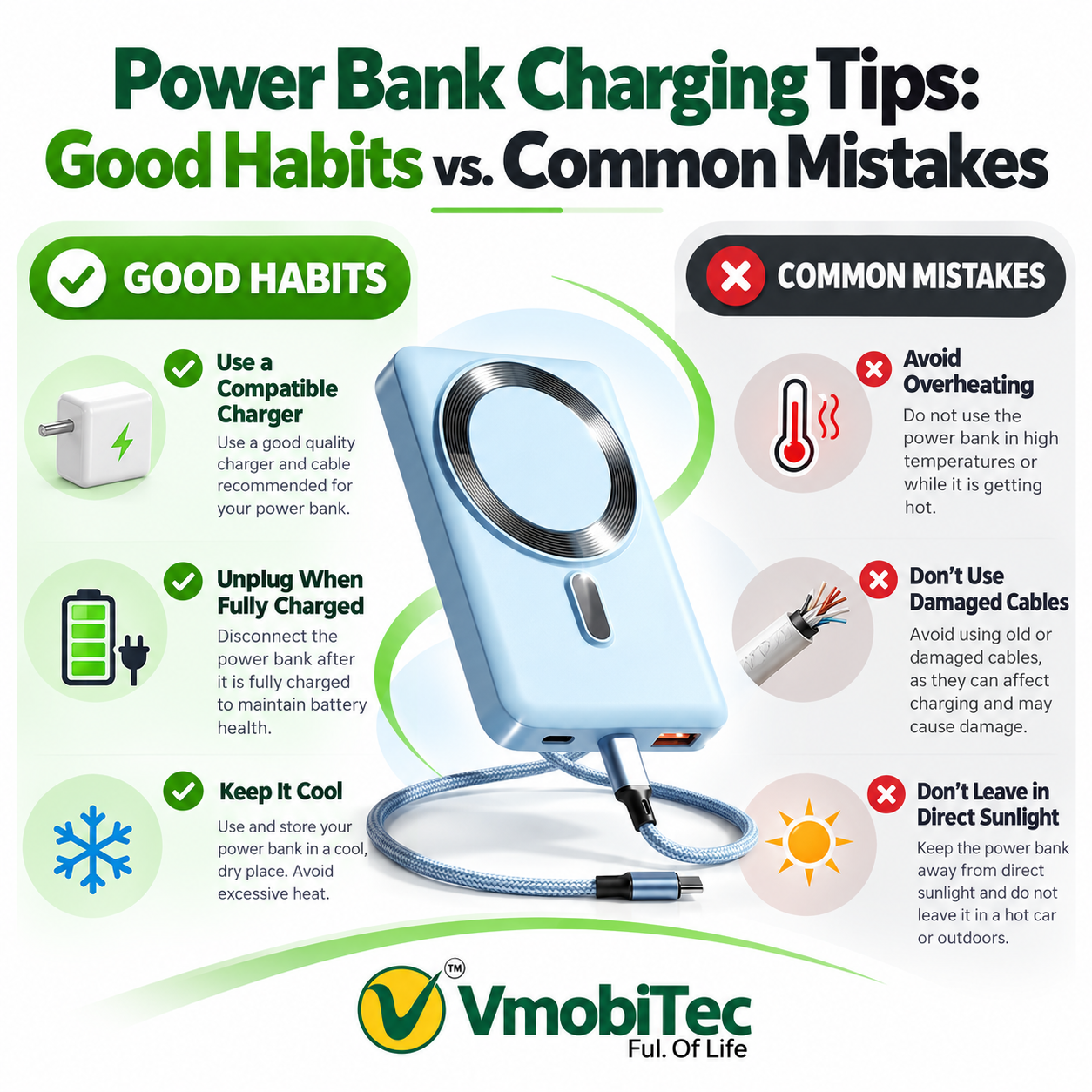
Power Bank Charging Tips: Good Habits vs. Common Mistakes
The following comparison summarises practical power bank charging tips that help reduce avoidable battery wear and improve safe usage.
| Good practice | Common mistake | Why it matters |
|---|---|---|
| Use a compatible charger | Using an unsuitable or damaged charger | May cause charging problems or excessive heat |
| Recharge before the battery is completely depleted | Frequently allowing it to remain at zero | Prolonged deep discharge can contribute to battery problems |
| Charge in a ventilated area | Charging under bedding or inside a bag | Trapped heat can increase safety risks |
| Disconnect after charging is complete | Leaving it connected unnecessarily | Reduces unnecessary charging time |
| Inspect cables and ports | Ignoring loose or damaged connectors | Faulty connections can interrupt charging |
| Store in a cool, dry place | Leaving it in a hot vehicle | High temperatures can accelerate battery ageing |
| Follow the rated output limits | Connecting more devices than supported | Can increase power demand and heat |
These practices support safe use, but they cannot stop the natural ageing of rechargeable batteries.
How to Prevent Power Bank Overheating
A power bank may become slightly warm while charging or powering another device. However, excessive heat, swelling, leakage, smoke, or unusual smells should never be ignored.
According to Huawei’s power bank troubleshooting guidance, charging conditions, fast charging, and poor ventilation can contribute to heat build-up. The Australian Competition and Consumer Commission’s power bank safety guide also advises users to avoid damaged or overheating power banks and keep them away from flammable surfaces.
Follow these precautions:
- Stop charging and disconnect connected devices if the power bank becomes unusually hot.
- Move away from direct sunlight and other heat sources.
- Do not cover the power bank or place it on a bed, sofa, or pillow while charging.
- Never open, puncture, or attempt to repair the battery yourself.
- Stop using the device if it swells, leaks, smokes, or develops an unusual smell.
If the power bank is smoking, hissing, or showing signs of fire, move away, keep others clear, and contact local emergency services. Do not handle or transport a failing battery.
Why Is Your Power Bank Draining Fast?
A power bank draining fast can indicate high power demand, inefficient charging, battery ageing, or a fault. Before replacing it, check how you use it and whether the problem occurs with different devices and cables.
Common causes include:
1. Charging multiple devices: Several connected devices increase the total power demand and can drain the power bank more quickly.
2. Heavy smartphone usage: Gaming, navigation, video recording, mobile hotspots, and high screen brightness can consume power while your phone charges.
3. Fast charging: Higher charging power can increase energy use and heat compared with slower charging, depending on the devices involved.
4. Battery ageing: An older power bank may store less energy than it did when new, even when its indicator shows a full charge.
5. Faulty cables or connections: Damaged cables and loose ports may cause interruptions or inefficient charging.
6. Incorrect expectations about capacity: Rated capacity does not equal the amount of energy delivered directly to a phone battery.
If the power bank drains unusually quickly even when charging one device under normal conditions, inspect the cables, check the manufacturer’s troubleshooting instructions, and consider professional support or replacement.
How to Maintain a Power Bank for Daily Use
Daily users can maintain their power banks by following a simple routine rather than performing complicated battery-care procedures.
- Before use: Check the casing, cable, and connectors for damage.
- During charging: Place the power bank on a stable, ventilated surface.
- After use: Disconnect the cable carefully and let the device cool if it has become warm.
- Every few weeks: Inspect the charging ports and clean the exterior with a dry cloth.
- During travel: Carry the power bank in a protective pouch, away from sharp or conductive objects.
- During long periods without use: Follow the manufacturer’s storage instructions and check the device periodically.
If you rely on a power bank every day, choose a model with sufficient capacity, compatible output, and suitable safety protections for your devices. Buying the right product is as important as maintaining it properly.
Benefits of Following Best Practices for Power Bank Maintenance
Consistent maintenance offers several practical benefits:
- Better battery care: Reduces avoidable stress caused by heat, poor storage, and unsuitable charging accessories.
- More reliable charging: Helps prevent interruptions caused by damaged cables or dirty connectors.
- Safer daily use: Encourages early detection of swelling, overheating, and physical damage.
- Better value for money: Helps you get the most practical use from your power bank before normal battery ageing reduces its performance.
- Improved travel readiness: Regular checks help ensure the device is ready when you need backup power.
- Fewer preventable problems: Correct storage and careful handling reduce the likelihood of damage from drops, moisture, and extreme temperatures.
Remember that maintenance cannot restore capacity already lost through battery ageing or repair an internally damaged battery.
Shop VMobiTec Power Banks for Reliable Everyday Charging
Keep your devices powered wherever life takes you with VMobiTec power banks in India. Explore portable charging solutions with different capacities, fast-charging outputs, and wireless charging features to find the right option for your smartphone and everyday needs. Compare the available models, check device compatibility, and choose a power bank that fits your budget and lifestyle.
Ready to stay powered on the go? Shop the VMobiTec Power Bank Collection today and find the right power bank for your next journey.
Frequently Asked Questions About How to Increase Power Bank Life
1. How to increase power bank life effectively?
Use a compatible charger and cable, avoid excessive heat, disconnect the power bank after charging is complete, and store it in a cool, dry place. Avoid repeated deep discharge and physical damage. Follow the manufacturer’s instructions because recommended charging and storage practices can vary by model.
2. How often should I charge my power bank?
Charge your power bank whenever its remaining capacity is insufficient for your needs. You do not have to wait until it reaches zero. The ideal charging frequency depends on your daily usage, capacity, and the manufacturer’s recommendations.
3. Should I fully discharge my power bank before recharging it?
No. Modern lithium-ion and lithium-polymer power banks generally do not need complete discharge before recharging. Repeatedly running the battery to zero is unnecessary, and leaving it fully discharged for a long period can cause problems.
4. How can I prevent my power bank from overheating?
Charge it in a well-ventilated area, use compatible charging accessories, and keep it away from sunlight, hot vehicles, and soft surfaces that trap heat. Stop using it if it becomes excessively hot, swells, leaks, or produces an unusual smell.
5. How should I store a power bank when it is not in use?
Keep it in a cool, dry place away from direct sunlight, moisture, and extreme temperatures. For extended storage, follow the manufacturer’s recommended charge level and check the device periodically. Avoid storing it fully discharged for a prolonged period.
6. Why is my power bank draining fast?
A power bank may drain quickly because of multiple connected devices, high smartphone power consumption, fast charging, battery ageing, or inefficient charging. Test it with a compatible cable and a single device. If the problem continues, consult the manufacturer or consider replacing a faulty unit.
7. How long does a power bank battery last?
There is no universal lifespan for all power banks. Battery quality, charging frequency, temperature, storage, and overall construction affect how long a unit remains useful. Monitor changes in charging capacity and reliability rather than relying on a fixed number of years.
8. Can I use my power bank while charging it?
Only do this if the manufacturer explicitly supports pass-through charging. Simultaneously charging the power bank and another device can increase heat and may not be supported by every model. Follow the product instructions and stop if excessive heat develops.
Final Thoughts: Make Your Power Bank Last Longer
Learning how to increase power bank life starts with a few consistent habits: use compatible charging accessories, avoid excessive heat, protect the device from physical damage, and store it correctly when not in use. These power bank battery maintenance tips can help preserve performance and support safer everyday charging.
For Indian users who depend on smartphones throughout the day, choosing a power bank with suitable capacity, compatible charging output, and reliable safety features is equally important. Explore the power bank options available from VMobiTec and compare specifications before choosing a model that suits your everyday charging needs.