Blog

IPX4 vs IPX7 Water Resistance: Which Is Better?
Water and electronics don’t make a good combination unless a device has been designed and tested for protection against moisture. That’s why understanding IPX4 vs IPX7 water resistance matters when you’re buying wireless earbuds, smartwatches, speakers, or other portable electronics.
The two ratings offer different levels of protection. IPX4 is designed to handle water splashes from multiple directions, while IPX7 provides protection against temporary immersion under specified test conditions. Choosing between them depends on how and where you use your device.
For everyday workouts and light rain, IPX4 may be enough. If accidental drops into water are a realistic possibility, IPX7 provides a higher level of water protection.
What Does IPX4 vs IPX7 Water Resistance Mean?
IPX4 vs IPX7 water resistance compares two levels of water protection defined within the IP Code system. The first character after “IP” normally describes protection against solid particles, while the second character represents protection against water.
The “X” means that no rating for protection against solid objects is specified in that particular IP rating. The final number is the part that matters when comparing IPX4 and IPX7.
IP ratings are based on standardized testing rather than marketing descriptions such as “waterproof” or “water-resistant.” The IEC 60529 standard defines the IP Code used to classify degrees of protection provided by enclosures.
IPX4 Water Resistance Meaning
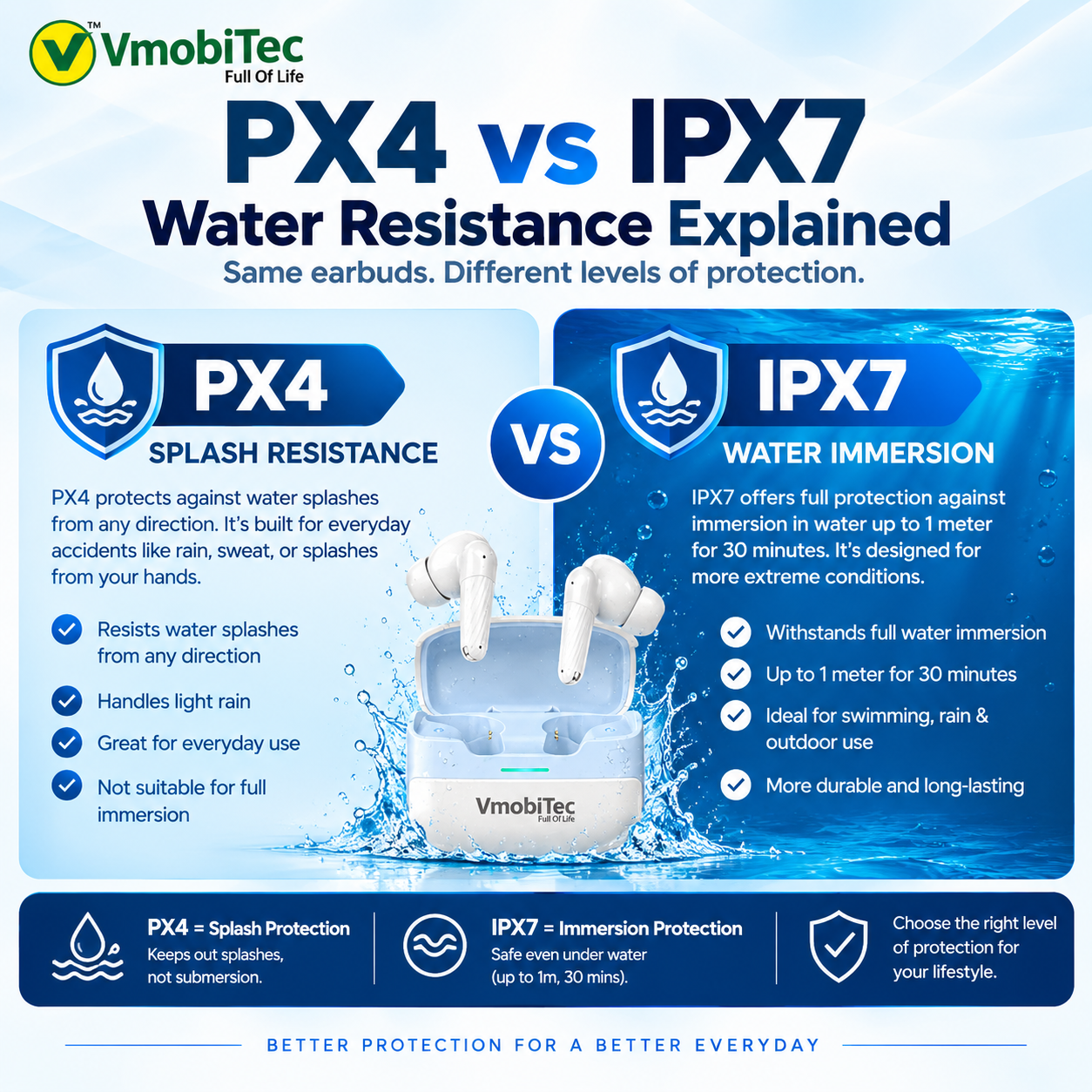
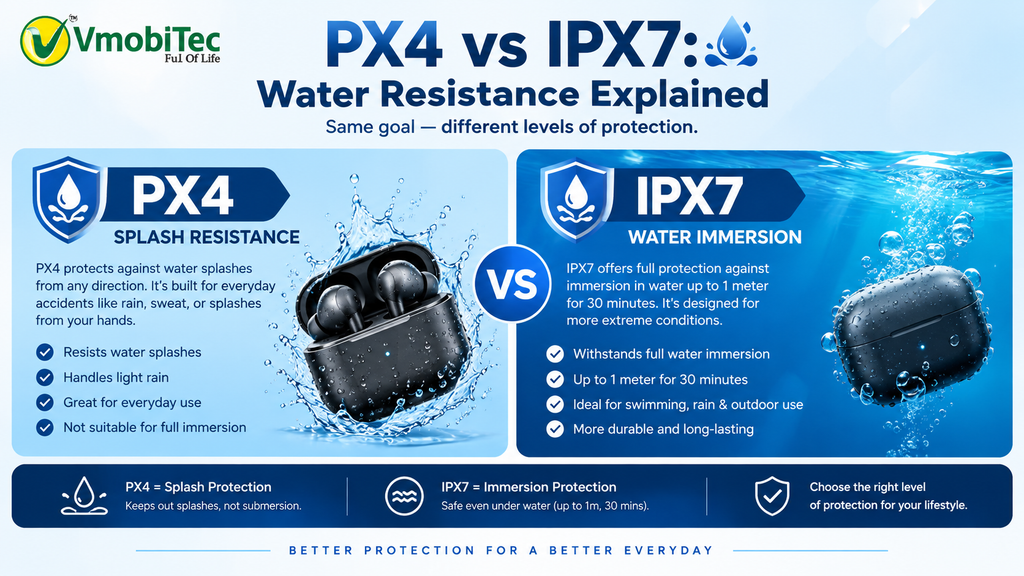
IPX4 water resistance meaning: IPX4 indicates protection against water splashes from any direction under the applicable test conditions.
An IPX4 device can be suitable for situations such as exercise, light rain, sweat, and accidental splashes. It isn’t designed for intentional submersion.
For earbuds, IPX4 can be a practical rating for normal daily use, particularly when the main concern is sweat and occasional exposure to water.
IPX7 Waterproof Rating Meaning
IPX7 waterproof rating meaning: IPX7 indicates protection against temporary immersion in water under specified test conditions.
For example, Samsung describes IPX7 on certain Galaxy devices as protection during immersion in up to 1 metre of fresh water for up to 30 minutes under controlled conditions.
That doesn’t mean an IPX7 product should routinely be used underwater. The rating describes a controlled test condition, not unlimited real-world waterproofing.
IPX4 vs IPX7 Protection: What’s the Difference?
IPX4 protects against splashing water, while IPX7 is designed to withstand temporary immersion under specified test conditions. IPX7 therefore represents a higher water-protection level than IPX4.
The difference becomes more meaningful when you consider how the device will actually be used. A person who only needs protection from sweat and occasional rain may not need IPX7.
Someone who regularly uses earbuds outdoors, near water, or during activities where accidental drops are possible may prefer IPX7.
IPX4 vs IPX7 Comparison Table
| Feature | IPX4 | IPX7 |
|---|---|---|
| Water protection | Splash protection | Temporary immersion protection |
| Protection level | Lower | Higher |
| Splashing water | Yes | Yes, within applicable testing scope |
| Rain exposure | Suitable for normal light exposure | Generally offers greater protection |
| Sweat | Suitable for many everyday uses | Generally stronger protection |
| Temporary immersion | No | Yes, under specified test conditions |
| Swimming | Not designed for swimming | Not automatically suitable for swimming |
| Showering | Not recommended unless manufacturer permits | Not automatically recommended |
| Typical use | Everyday, gym, light rain | Higher-moisture environments |
| Protection rating | IPX4 | IPX7 |
The biggest mistake is assuming that IPX7 means a device is suitable for every water-related activity. The manufacturer’s own instructions still matter.
How IPX4 Water Protection Works in Everyday Use
IPX4 water protection is intended to protect an enclosure from splashing water from different directions. This makes IPX4 useful for common situations where electronics encounter small amounts of moisture.
Think about a pair of wireless earbuds during a workout. Sweat can reach the earbuds, and occasional splashes can occur when you’re cleaning equipment or walking outside in light rain.
IPX4 can provide useful protection in these circumstances when the product has been properly designed and tested.
Is IPX4 Good for Gym and Exercise?
Yes, IPX4 can be suitable for many gym and exercise scenarios because it provides protection against splashing water.
However, sweat resistance isn’t the same as complete protection against moisture. Charging cases, microphones, speakers, buttons, and exposed ports may have different protection considerations.
Always check the manufacturer’s specifications for the complete product rather than assuming every component has the same rating.
Is IPX4 Good for Rain?
IPX4 can handle water splashes, making it more suitable than an unrated device for everyday exposure to light rain.
Heavy rain, prolonged exposure, water pressure, or water entering through openings can present different risks. If you regularly use electronics outdoors, a higher rating may provide greater peace of mind.
How IPX7 Water Protection Works
IPX7 water protection is designed for temporary immersion under specified test conditions. This makes IPX7 a stronger water-protection rating than IPX4 for accidental immersion.
The distinction is straightforward: IPX4 focuses on splashing water, while IPX7 addresses temporary immersion.
Samsung’s guidance, for example, explains IPX7 protection using immersion up to 1 metre for up to 30 minutes under test conditions for applicable devices. Samsung also warns that water resistance can weaken over time.
Does IPX7 Mean Waterproof?
Not necessarily.
The word “waterproof” can create the impression that a device is completely protected against water in every situation. IP ratings are more specific.
IPX7 indicates protection under a defined immersion test. It doesn’t automatically mean the device can withstand swimming, diving, high-pressure water jets, saltwater, soapy water, or every other type of liquid exposure.
That distinction matters when choosing earbuds and other portable electronics.
Can IPX7 Earbuds Be Used in Water?
An IPX7 rating provides a higher level of protection against temporary immersion, but users should still follow the manufacturer’s instructions.
Some manufacturers specifically warn against using their products in swimming pools, seawater, showers, or other environments despite an IPX7 rating. Samsung, for example, provides additional guidance around water exposure for Galaxy devices and earbuds.
IPX4 vs IPX7 Water Resistance for Earbuds
IPX4 earbuds are generally suited to sweat, splashes, and everyday moisture, while IPX7 earbuds offer stronger protection against accidental temporary immersion.
For most earbud buyers, the right rating depends on lifestyle rather than simply choosing the largest number.
A commuter who occasionally walks through rain may be perfectly comfortable with IPX4. A runner who frequently trains outdoors or someone who has previously dropped earbuds into water may prefer IPX7.
What Should You Check Besides the IP Rating?
The IP rating isn’t the only specification worth checking.
Look at:
- Earbud water-resistance rating
- Charging case protection
- Manufacturer’s water-use restrictions
- Warranty conditions
- Bluetooth version
- Battery life
- Charging method
- Noise cancellation
- Microphone quality
- Fit and comfort
- Replacement and after-sales support
The charging case deserves special attention. Some earbuds may have water-resistant earbuds but a charging case that isn’t designed for the same exposure. Samsung specifically provides product-level guidance showing that water resistance can differ between components.
IPX4 vs IPX7 Water Resistance for Different Activities
The best IP rating depends on the environment, because splash protection and immersion protection solve different problems.
Here’s how the ratings generally compare for common situations.
| Activity | IPX4 | IPX7 |
|---|---|---|
| Gym workouts | Good | Very good |
| Sweat exposure | Good | Very good |
| Light rain | Good | Very good |
| Outdoor commuting | Good | Very good |
| Accidental water splash | Good | Very good |
| Accidental temporary drop in water | Not designed for it | Better suited |
| Swimming | No | Don’t assume suitability |
| Diving | No | No |
| High-pressure water | No | No |
| Saltwater exposure | Not recommended | Check manufacturer |
| Soapy water | Not recommended | Check manufacturer |
The table is a practical buying guide, not a replacement for the manufacturer’s instructions. Water resistance is tested under defined conditions, and real-world exposure can be more complicated.
Benefits of Choosing IPX4 Water Resistance
IPX4 is a practical choice when you mainly need protection against everyday splashes and sweat.
- Everyday moisture protection: Useful for normal activities involving occasional splashes.
- Workout-friendly: Suitable for many gym and exercise situations.
- Light rain protection: Offers more protection than an unrated enclosure against splashing water.
- Practical for daily users: A sensible rating when immersion isn’t part of the expected use.
- Often sufficient for earbuds: Many users don’t need immersion-level protection for ordinary listening.
IPX4 can be the right choice when you’re paying for protection you will actually use rather than choosing a higher rating simply because it sounds better.
Benefits of Choosing IPX7 Water Resistance
IPX7 provides stronger protection when accidental immersion is a realistic concern.
- Higher water protection: IPX7 is designed for temporary immersion under specified conditions.
- Greater accident protection: Useful when devices may accidentally fall into water.
- Outdoor versatility: Can provide additional protection for users who spend more time outdoors.
- Useful for active lifestyles: A higher rating can be valuable for people who regularly encounter moisture.
- Better protection margin: IPX7 gives users more protection against certain water incidents than IPX4.
A higher rating doesn’t eliminate the need for sensible handling. Keep charging ports and cases dry when instructed by the manufacturer.
IPX4 vs IPX7: Which One Should You Buy?
Choose IPX4 for normal sweat, splashes, and light rain; choose IPX7 when temporary accidental immersion is a realistic concern.
The decision is easier when you start with your actual routine.
If you use earbuds primarily at your desk, while commuting, or during regular workouts, IPX4 may provide enough protection.
If you’re more active outdoors, frequently around water, or concerned about accidental drops, IPX7 provides a stronger protection level.
Choose IPX4 If You:
- Mainly use earbuds for daily listening
- Exercise indoors
- Need protection against sweat
- Occasionally encounter light rain
- Don’t expect the device to be submerged
- Want practical water protection without paying for unnecessary specifications
Choose IPX7 If You:
- Exercise outdoors frequently
- Are concerned about accidental drops in water
- Spend more time around water
- Want stronger protection against temporary immersion
- Prefer a higher water-resistance specification
The best product isn’t necessarily the one with the highest IP number. It is the product whose protection level matches your actual use.
Common Mistakes When Comparing IPX4 and IPX7
The most common mistake is treating IPX7 as unlimited waterproofing or assuming IPX4 protects against immersion.
Mistake 1: Assuming IPX4 Is Waterproof
IPX4 is splash protection, not immersion protection. Don’t intentionally submerge an IPX4 device.
Mistake 2: Treating IPX7 as Swimming Protection
IPX7 is based on specified temporary immersion testing. Swimming introduces movement, longer exposure, chemicals, and other conditions that may fall outside the rating.
Mistake 3: Ignoring the Charging Case
Wireless earbuds are usually sold with a charging case, but the case may have a different water-resistance specification.
Mistake 4: Ignoring Saltwater and Pool Water
Freshwater testing doesn’t mean saltwater or chlorinated pool water is equally safe. Follow the manufacturer’s instructions.
Mistake 5: Charging a Wet Device
Moisture around charging contacts or ports can cause problems. Allow the device to dry completely according to the manufacturer’s instructions before charging.
Mistake 6: Assuming Water Resistance Lasts Forever
Water resistance can deteriorate with age, wear, physical damage, repairs, and exposure conditions. Samsung explicitly warns that water resistance may decrease over time.
How to Choose Water-Resistant Earbuds from Vmobitec
Choosing water-resistant earbuds from Vmobitec should start with the product’s stated IP rating and the manufacturer’s recommended usage conditions.
Before purchasing, check the product specifications rather than relying only on phrases such as “sports earbuds” or “water-resistant.”
1. Check the Exact IP Rating
Look for the complete rating, such as IPX4 or IPX7. The number tells you the type of water protection being claimed under the relevant testing standard.
2. Match the Rating to Your Lifestyle
Think about where you’ll use the earbuds. Gym use, commuting, outdoor running, travel, and water-based activities can create very different requirements.
3. Check the Charging Case
Don’t assume that the charging case has the same protection as the earbuds.
4. Read the Manufacturer’s Instructions
Look for restrictions involving swimming, showering, saltwater, pool water, soap, and charging.
5. Consider Other Earbud Features
Water resistance is only one part of a good earbud. Battery life, Bluetooth connectivity, microphone performance, comfort, audio quality, ENC or ANC, and charging speed can all affect the buying decision.
6. Buy Based on Actual Use
A higher rating is useful only when it solves a real problem. For many everyday users, IPX4 can be sufficient.
IPX4 vs IPX7 Water Resistance: What the IP Code Really Tells You
The IP Code provides a standardized way to describe protection provided by electrical enclosures against specific external conditions.
IEC 60529 is the international standard associated with the IP Code. The code uses numbers and letters to communicate different types and levels of protection.
In IPX4 and IPX7:
- IP = Ingress Protection
- X = No solid-particle protection rating specified
- 4 = Protection against water splashes
- 7 = Protection against temporary immersion under specified conditions
The numbers aren’t a simple measure of “how waterproof” something is. Each number represents a defined type of protection.
That is why IPX7 shouldn’t simply be described as “almost twice as waterproof as IPX4.” The two ratings represent different test conditions.
Does a Higher IP Rating Always Mean Better?
A higher IP rating isn’t automatically better for every buyer because different ratings address different types of exposure.
For example, someone who only needs splash protection may have no practical reason to prioritize IPX7.
There is also another important point: IPX7 doesn’t automatically cover every lower water-exposure scenario in every direction or every condition. Product manufacturers may provide additional ratings or instructions for specific use cases.
Experienced buyers should therefore look at the complete specification sheet rather than choosing a product based on one number.
Vmobitec IPX4 vs IPX7 Waterproof Rating Comparison
A Vmobitec IPX4 vs IPX7 waterproof rating comparison should focus on the intended use of each product rather than treating the ratings as interchangeable.
For Vmobitec customers, the practical question is simple: what kind of moisture will the device encounter?
If the expected exposure is sweat, occasional splashing, and light rain, IPX4 can be a sensible specification.
If accidental immersion is a realistic possibility, an IPX7-rated product may provide a stronger safety margin.
When comparing Vmobitec devices, always verify the exact rating listed on the individual product page because water resistance is product-specific.
How to Protect Water-Resistant Electronics
Water-resistant devices still need proper care because resistance is not permanent or unlimited.
Follow these practical habits:
- Avoid intentional submersion unless the manufacturer specifically permits it.
- Keep charging cases and charging ports dry.
- Don’t charge a device while it is wet.
- Avoid unnecessary exposure to saltwater and chlorinated water.
- Keep soap and cleaning chemicals away from water-resistant electronics.
- Inspect devices for cracks or physical damage.
- Follow the manufacturer’s drying and cleaning instructions.
- Don’t assume an older device retains its original water resistance indefinitely.
Proper handling protects the electronics and reduces the chance of moisture-related damage.
Frequently Asked Questions About IPX4 vs IPX7 Water Resistance
Q: Is IPX7 better than IPX4?
A: Yes, IPX7 provides a higher level of water protection against temporary immersion than IPX4, which is designed for splashing water. However, IPX7 isn’t automatically suitable for swimming, diving, or every type of water exposure. Always check the manufacturer’s specific instructions before using an IPX7-rated device around water.
Q: What is the IPX4 water resistance meaning?
A: IPX4 means a device enclosure is protected against water splashes from different directions under the applicable test conditions. IPX4 is commonly useful for everyday moisture, sweat, and light rain. It isn’t designed to protect a device during intentional or prolonged immersion in water.
Q: What is the IPX7 waterproof rating meaning?
A: IPX7 indicates protection against temporary immersion under specified testing conditions. A commonly cited example is immersion to 1 metre for up to 30 minutes under controlled conditions. IPX7 provides stronger immersion protection than IPX4, but users should still follow the product manufacturer’s water-use restrictions.
Q: Is IPX4 good for earbuds?
A: IPX4 can be a good rating for earbuds used during everyday activities, workouts, and light rain because it provides splash protection. It isn’t designed for immersion. Users should also check whether the charging case has its own water-resistance rating before exposing the complete earbud system to moisture.
Q: Can I swim with IPX7 earbuds?
A: You shouldn’t assume that IPX7 earbuds are suitable for swimming. IPX7 describes protection during specified temporary immersion testing, while swimming introduces movement, extended exposure, and potentially treated or salt water. Always follow the specific manufacturer’s instructions before using earbuds in a pool or open water.
Q: Is IPX7 safe in rain?
A: IPX7 provides a higher level of water protection than IPX4, including protection against temporary immersion under specified conditions. However, rain exposure can vary significantly in intensity and duration. Check the manufacturer’s instructions, especially for charging ports, cases, microphones, and other exposed components.
Q: Does IPX7 mean completely waterproof?
A: No. IPX7 is a defined water-protection rating, not a guarantee of unlimited waterproofing. It covers temporary immersion under specified test conditions. It doesn’t automatically cover high-pressure water, prolonged immersion, diving, saltwater, chemicals, or swimming. Product-specific instructions should always take priority.
Q: Which is better for a workout, IPX4 or IPX7?
A: Both can be suitable depending on the workout and environment. IPX4 is generally sufficient for sweat and ordinary gym use, while IPX7 provides additional protection against temporary immersion. If your workouts involve frequent outdoor exposure or a higher risk of accidental water drops, IPX7 may be the more suitable choice.
Final Verdict: IPX4 vs IPX7 Water Resistance
IPX4 is designed for splash protection, while IPX7 provides protection against temporary immersion under specified test conditions. For everyday workouts, sweat, and light rain, IPX4 can be enough. For users who face a greater risk of accidental immersion, IPX7 offers stronger protection.
When comparing Vmobitec products, don’t choose an IP rating in isolation. Check the complete specifications, charging-case protection, manufacturer’s restrictions, and your actual usage environment.
Choose the protection level that fits your routine, then compare the features that matter most for comfort, battery life, sound quality, charging, and durability.