Blog
Power Banks Online in India – Fast Charging & High Capacity | Vmobitec

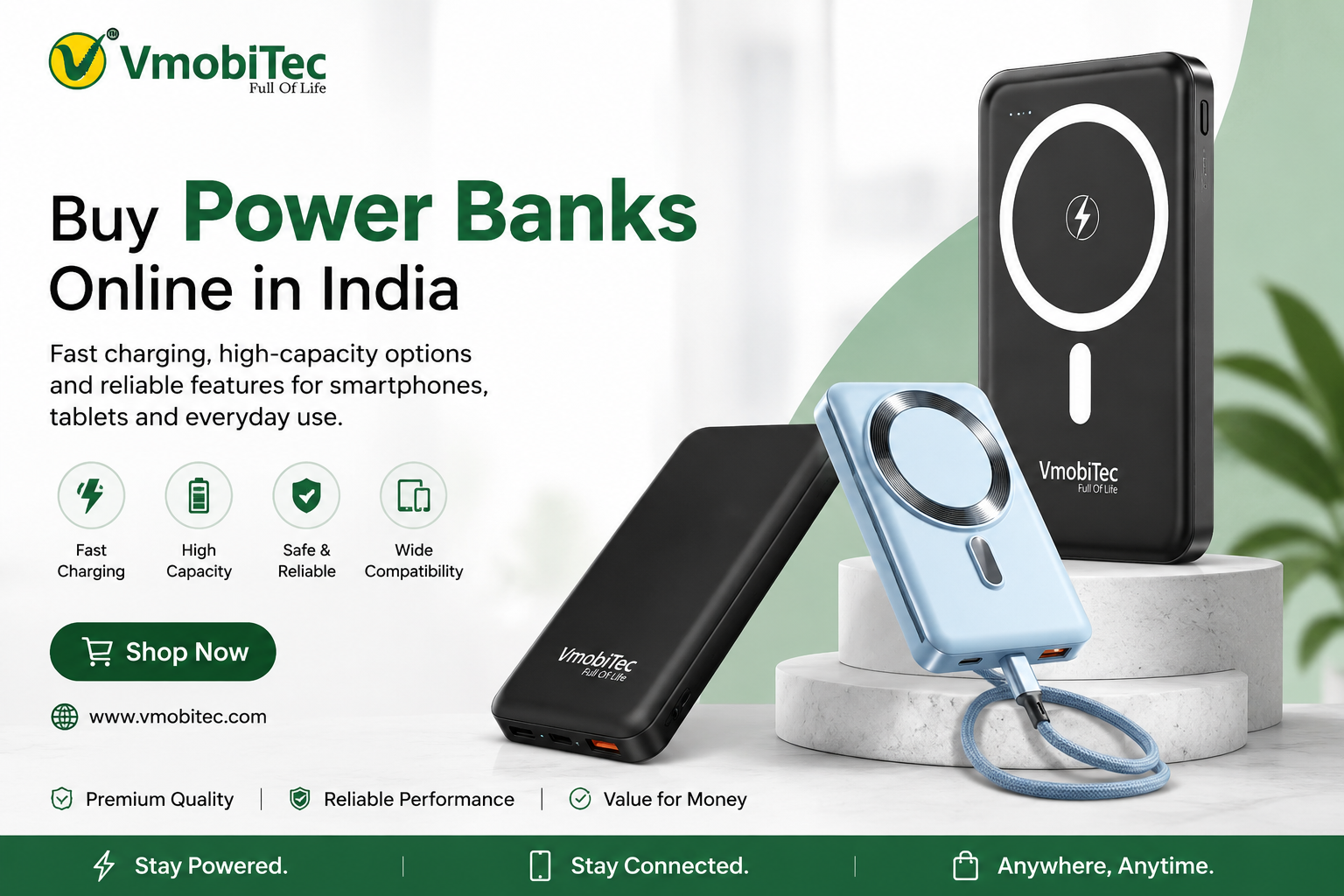
Power Banks Online in India: Choose the Right Portable Charger
A power banks keeps your smartphone and other USB-powered devices charged when a wall socket isn’t available. For students, professionals, travellers, gamers and everyday smartphone users in India, choosing the right capacity, charging speed and connectivity can make a noticeable difference.
VMobitec offers multiple power bank options designed around different charging requirements, including compact everyday models, fast-charging power banks and wireless charging options. Before buying, shoppers should compare battery capacity, output wattage, USB ports, charging protocols, compatibility, size and safety features rather than choosing only by mAh.
Quick Summary: Power Banks
A power bank is a portable rechargeable battery used to charge smartphones and compatible electronic devices away from a wall outlet. The right model depends on your device, required capacity, charging speed, portability and charging connections. For most smartphone users, a 10,000mAh power bank offers a practical balance between capacity and portability, while higher-capacity models suit longer trips and heavier use.
What Is a Power Banks ?
A power bank is a portable battery pack that stores electrical energy and delivers it through USB or compatible charging connections. It allows users to recharge smartphones, earbuds, smartwatches and other compatible devices when mains power isn’t readily available.
A typical power bank contains rechargeable battery cells, a charging circuit, protection electronics and one or more output ports. The device itself must first be charged before it can transfer stored energy to another device.
Power banks vary considerably in capacity, physical size, output power and charging technology. A compact model may prioritize portability, while a high-wattage model may be designed for phones, tablets or selected laptops.
How Does a Power Bank Work ?
A power bank follows a simple energy-storage process:
- Input: The internal battery is charged through an input port.
- Storage: Electrical energy is stored in the rechargeable cells.
- Conversion: Internal electronics regulate the stored energy.
- Output: Power is delivered through a USB or compatible output.
- Device charging: The connected smartphone or electronic device receives the available power.
The actual energy delivered to a device is lower than the nominal battery capacity because conversion and charging losses occur.
How to Choose a Power Banks
The best power bank depends on capacity, charging speed, ports, compatibility, portability and safety features. Capacity alone doesn’t tell you whether a particular model is suitable for your phone.
Experienced buyers should start with the device they intend to charge. A smartphone user who needs emergency backup power has different requirements from someone travelling for several days or charging multiple devices.
1. Check Battery Capacity
Power bank capacity is normally expressed in mAh, or milliamp-hours.
Common capacity categories include:
| Capacity | Best Suited For | Portability |
|---|---|---|
| 5,000mAh | Emergency smartphone charging | Very high |
| 10,000mAh | Everyday smartphone users | High |
| 20,000mAh | Travel and multiple charges | Medium |
| 25,000mAh+ | Heavy-duty use and multiple devices | Lower |
Actual charging performance depends on the power bank’s cell voltage, conversion efficiency and the receiving device.
2. Check Output Wattage
Output wattage indicates how much electrical power the power bank can provide under supported conditions.
For example, a power bank advertised with 22.5W output can potentially deliver significantly faster charging than a basic low-output model when the connected phone supports the relevant charging protocol.
However, a 22.5W power bank won’t necessarily charge every phone at 22.5W. The smartphone and power bank must negotiate a compatible charging mode.
3. Look at the Ports
USB-A and USB-C remain common interfaces for portable charging.
USB-C is increasingly useful because the same connector can support charging input and output on compatible products. Some power banks also include multiple outputs so users can charge more than one device.
4. Consider Portability
Higher capacity normally means a larger and heavier product.
For everyday carry, a 10,000mAh power bank can be a practical compromise between battery capacity and portability. Travellers who need more energy may prefer a 20,000mAh or larger model.
Power Bank Capacity: What Does mAh Mean?
mAh measures electrical charge capacity, not directly the amount of energy delivered to your phone. This distinction explains why a 10,000mAh power bank doesn’t necessarily provide exactly 10,000mAh to a smartphone battery.
The internal cells operate at a different voltage from the USB output, and the power bank uses electronic conversion to provide the required output voltage. Energy is lost during this process.
For a more meaningful comparison, consider both mAh capacity and watt-hours (Wh) where the manufacturer provides the information.
Is a 10,000mAh Power Banks Enough?
A 10,000mAh power bank is usually a practical choice for everyday smartphone backup charging. It provides more capacity than compact emergency chargers while remaining relatively portable.
Actual recharge count depends on the phone’s battery capacity, charging efficiency, power conversion losses and charging behavior.
For example, a smartphone with a battery around 5,000mAh shouldn’t be expected to receive two complete 0–100% charges from a nominal 10,000mAh power bank because real-world energy conversion isn’t lossless.
Fast Charging Power Banks
A fast-charging power bank can reduce charging time when both the power bank and connected device support compatible fast-charging standards.
Common technologies and terms found in modern charging products include:
- USB Power Delivery (USB PD)
- Qualcomm Quick Charge
- Programmable Power Supply (PPS)
- USB-C Power Delivery
- Fast-charging proprietary protocols
The exact charging speed depends on the charger, power bank, cable and smartphone.
A high-wattage power bank paired with a low-rated cable or incompatible device won’t automatically provide maximum charging speed.
Why USB-C PD Matters
USB Power Delivery allows compatible devices to negotiate charging power over USB-C.
This can make USB-C PD power banks useful for smartphones, tablets and selected laptops. Buyers should check the exact input/output specifications because USB-C ports do not automatically mean that a product supports high-wattage USB PD.
Power Banks With Wireless Charging
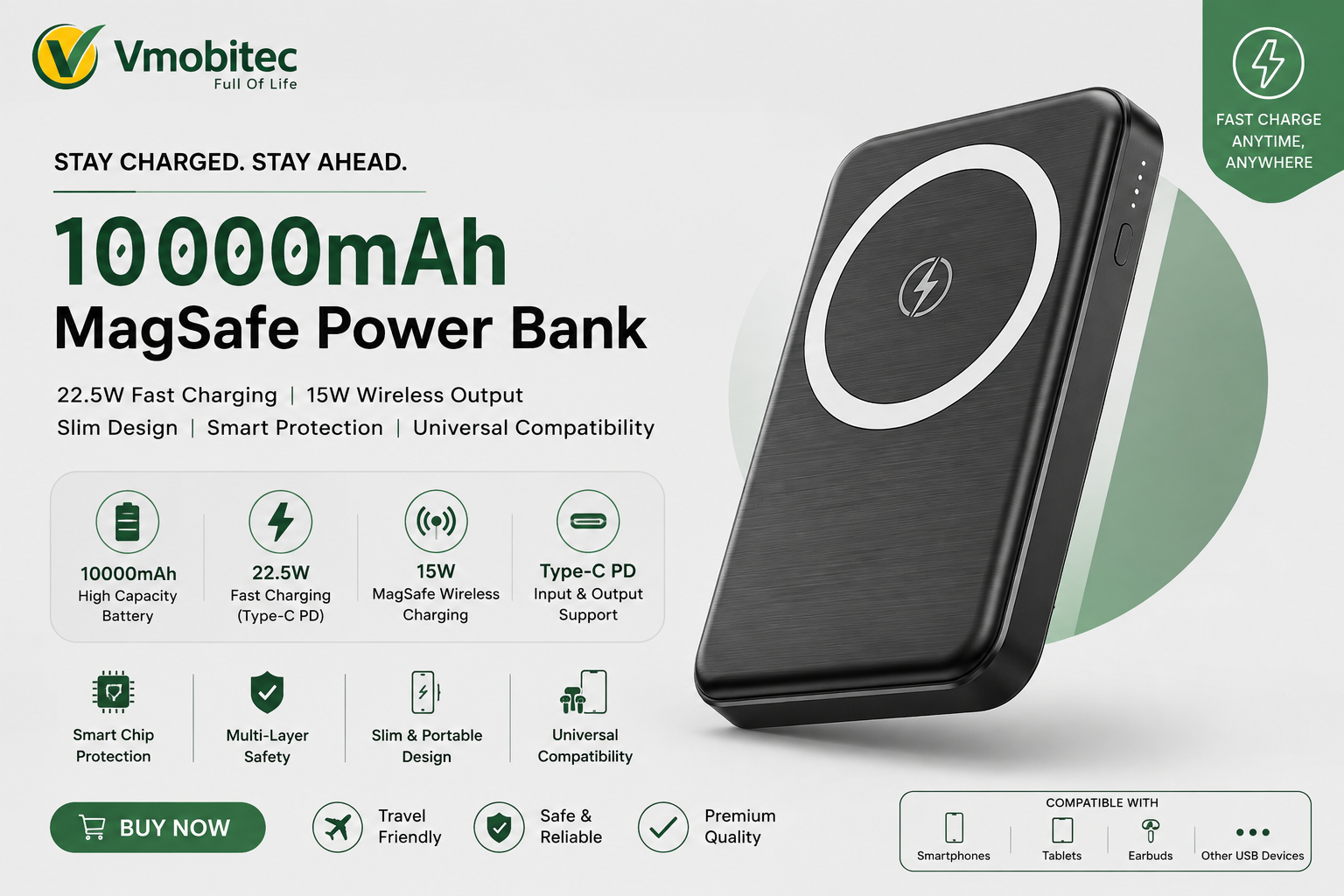
Wireless charging power banks combine portable battery storage with a wireless charging surface for compatible smartphones and accessories.
Wireless models can be convenient because they reduce cable dependence. However, wireless charging generally involves additional energy losses compared with a direct wired connection.
A wired connection is usually preferable when maximum charging efficiency or speed is the priority. Wireless charging is attractive when convenience and cable-free use matter more.
MagSafe-Compatible Power Banks
Some wireless power banks are designed to align magnetically with compatible Apple devices or cases.
Buyers should distinguish between MagSafe-compatible magnetic attachment and official MagSafe certification. Product descriptions should clearly state the type of compatibility being offered.
Power Bank for Smartphones
The best power bank for a smartphone should match the phone’s charging requirements, battery capacity and preferred charging protocol.
Before buying, check:
- Smartphone battery capacity
- Maximum supported charging wattage
- USB-C or USB-A requirements
- Fast-charging protocol
- Cable compatibility
- Number of devices you need to charge
- Desired power bank size
For everyday users, a portable 10,000mAh model may be enough. Heavy users and travellers may benefit from 20,000mAh or higher capacity.
Power Bank for Travel
A travel power bank should balance capacity, portability, charging speed and airline requirements.
Travellers should check current airline and airport rules before flying because restrictions can apply to spare lithium batteries and power banks, particularly based on watt-hour ratings and how the battery is carried.
A 10,000mAh or 20,000mAh model may be suitable for many travel scenarios, but the correct choice depends on the number of devices and the duration of the trip.
For air travel, keep the power bank in your cabin baggage and verify the applicable airline’s current policy before departure.
Power Banks Safety Features
Safety electronics are essential in a power bank because lithium-ion and lithium-polymer batteries require controlled charging and discharging.
A quality power bank may include protection against:
- Overcharging
- Over-discharging
- Short circuits
- Excess current
- Excess temperature
- Voltage irregularities
Buyers should also avoid damaged, swollen or unusually hot power banks. Use the charging cable and adapters recommended by the manufacturer where applicable.
Why Certification and Build Quality Matter
A power bank is a battery-powered electronic device, so build quality and protection circuitry deserve more attention than appearance alone.
Look for clear manufacturer specifications, warranty information and applicable compliance or safety information. Avoid products with exaggerated capacity claims or incomplete technical specifications.
Power Bank Comparison: Which Type Is Right for You?
| Power Bank Type | Typical Capacity | Best For | Main Advantage |
|---|---|---|---|
| Compact | 5,000mAh | Emergency charging | Lightweight |
| Everyday | 10,000mAh | Smartphones | Balance of size and capacity |
| High Capacity | 20,000mAh | Travel | More stored energy |
| Fast Charging | Varies | Quick smartphone charging | Higher output |
| Wireless | Varies | Cable-free charging | Convenience |
| Multi-port | Varies | Multiple devices | Charge several devices |
No single power bank is ideal for every user. The right choice depends on how often you need backup power and which devices you carry.
VMobitec Power Banks: Options for Different Users
VMobitec power banks are positioned as portable charging options for Indian consumers looking for different combinations of capacity, charging speed and functionality.
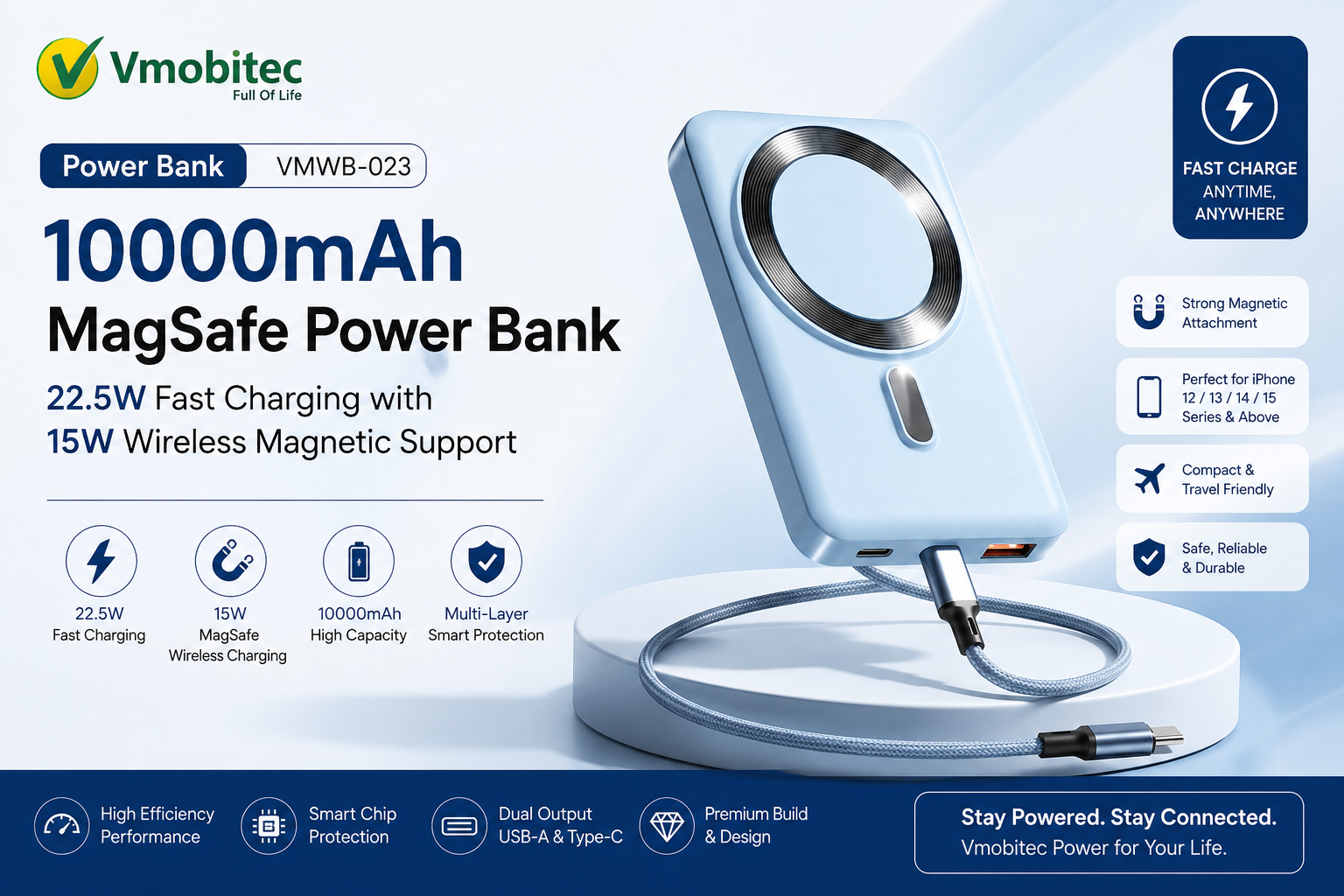
The VMobitec range can be evaluated according to the type of user rather than simply selecting the largest capacity.
Everyday Smartphone Users
A compact or 10,000mAh model can suit users who mainly need backup power during commuting, college, work or daily travel.
Heavy Smartphone Users
Users who spend long hours away from a wall charger can consider higher-capacity models or faster-charging options.
Travellers
A higher-capacity power bank can provide additional backup for smartphones, earbuds and other USB-powered accessories.
Wireless Charging Users
Wireless power banks can be considered by users who prefer cable-free charging and have compatible smartphones or accessories.
Why Buy a Power Bank From VMobitec?
VMobitec provides multiple mobile-accessory options for Indian consumers, allowing shoppers to compare power banks according to capacity, charging speed and intended use.
Key buying considerations include:
- Multiple capacity options: Choose a model based on everyday or travel requirements.
- Fast-charging choices: Higher-output models are available for compatible devices.
- Portable designs: Select compact options when carrying convenience matters.
- Multiple charging technologies: Depending on the model, features may include USB-C, USB-A or wireless charging.
- Smartphone-focused accessories: Power banks complement other mobile charging products available from VMobitec.
- Online shopping convenience: Customers can compare specifications before selecting a suitable model.
Product-level specifications should always be checked before purchase because capacity, ports, charging protocols and features vary between models.
Power Bank vs Wall Charger
A power bank provides portable charging, while a wall charger depends on access to a mains power outlet. Many smartphone users benefit from having both.
| Feature | Power Bank | Wall Charger |
|---|---|---|
| Portability | Excellent | Limited |
| Requires wall outlet during use | No | Yes |
| Battery storage | Yes | No |
| Travel use | Excellent | Useful where outlets exist |
| Emergency charging | Excellent | Limited |
| Multiple device charging | Model dependent | Model dependent |
A power bank is a backup energy source. A wall charger is the primary charging solution when mains electricity is available.
How to Use a Power Bank Correctly
Using a power bank correctly means charging it with compatible equipment, keeping it in good condition and avoiding physical damage or extreme heat.
- Charge the power bank: Use the recommended input connection and compatible charger.
- Check the indicator: Confirm that sufficient charge is available.
- Connect your device: Use a suitable USB cable.
- Monitor charging: Allow the device and power bank to operate normally.
- Disconnect when appropriate: Remove the cable when charging is complete or when the power bank is no longer required.
- Store safely: Keep the power bank away from excessive heat, moisture and physical damage.
Don’t use a power bank that is swollen, cracked, leaking or abnormally hot.
Common Power Bank Buying Mistakes
Many power bank buying mistakes happen because shoppers focus on mAh while ignoring output, compatibility, size and safety.
Choosing Capacity Without Checking Weight
A larger battery isn’t always better if you need something for daily carrying.
Ignoring Output Wattage
A high-capacity power bank with low output may not provide the charging speed you expect.
Assuming USB-C Means Fast Charging
USB-C is a connector standard. It doesn’t automatically guarantee a particular charging wattage or protocol.
Buying Based Only on MRP
Price should be evaluated alongside capacity, output, warranty, build quality and features.
Ignoring the Cable
The cable can affect charging performance. Use a cable suitable for the required charging power and protocol.
How to Choose the Best Power Bank for Your Needs
Choosing the best power bank starts with identifying your primary device, daily usage and required charging speed.
Use this simple decision process:
- Identify your device: Smartphone, tablet, earbuds or other electronics.
- Check battery capacity: Find your device’s battery specifications.
- Determine required output: Check the maximum supported charging speed.
- Choose capacity: Select 5,000mAh, 10,000mAh, 20,000mAh or another suitable capacity.
- Check ports: Choose USB-C, USB-A, wireless or multi-port options as needed.
- Consider portability: Balance battery capacity against size and weight.
- Review safety information: Look for clear specifications and protection features.
- Compare products: Check the complete specifications before purchasing.
This approach is more reliable than choosing a power bank based on capacity or price alone.
Frequently Asked Questions About Power Banks
Q: What is a power bank used for?
A: A power bank is a portable rechargeable battery used to charge compatible electronic devices without a direct wall outlet. Smartphones are the most common use, but suitable models can also charge tablets, wireless earbuds, smartwatches and selected other USB-powered devices.
Q: Which power bank is best for a smartphone?
A: The best power bank for a smartphone depends on battery capacity, charging speed, portability and compatibility. A 10,000mAh model is a practical everyday option for many users, while 20,000mAh models are better suited to longer trips or heavier charging requirements.
Q: Is a 10,000mAh power bank enough?
A: A 10,000mAh power bank is suitable for many everyday smartphone users who need portable backup power. The actual energy delivered to a phone is lower than the nominal capacity because voltage conversion and charging losses occur. Phone battery size and charging efficiency also affect the number of charges.
Q: Does a higher mAh power bank charge faster?
A: No. mAh measures capacity, while charging speed is primarily determined by output power and compatible charging protocols. A 10,000mAh power bank with higher supported wattage can charge a compatible smartphone faster than a larger-capacity power bank with lower output.
Q: Can a power bank charge a laptop?
A: Some high-output USB-C power banks can charge compatible laptops, but not every power bank is suitable. Check the laptop’s required charging wattage and the power bank’s USB-C Power Delivery output before purchasing. The cable must also support the required power level.
Q: Are wireless power banks better than wired power banks?
A: Wireless power banks are more convenient when cable-free charging is supported by the smartphone, while wired charging is generally preferable when efficiency and charging speed are the priority. The better option depends on whether convenience or direct charging performance matters more.
Q: How long does a power bank last?
A: Power bank lifespan depends on battery chemistry, charging cycles, operating temperature, storage conditions and usage. Battery capacity gradually decreases over time. Good charging practices, avoiding excessive heat and using compatible charging equipment can help maintain battery performance.
Q: Can I carry a power bank on an airplane?
A: Power bank rules vary by airline and jurisdiction, and spare lithium batteries are generally subject to specific conditions. Passengers should check the current airline and airport requirements before travelling. Power banks are commonly required to be carried in cabin baggage rather than checked baggage.
Shop Power Banks Now
Final Verdict: Which Power Banks Should You Buy?
The right power bank is the one that matches your smartphone or other devices, required charging speed, capacity needs and portability preferences. For many everyday users, 10,000mAh offers a practical balance, while frequent travellers and heavy users may prefer higher-capacity models.
VMobitec gives shoppers different mobile-accessory options to compare, but each power bank should be evaluated using its individual specifications rather than capacity alone. Check output wattage, ports, charging protocols, safety features and compatibility before placing an order.