Blog
45W Fast Charging & Battery Health: Does It Damage Your Battery?

45W Fast Charging Battery Health: What Actually Happens to Your Phone
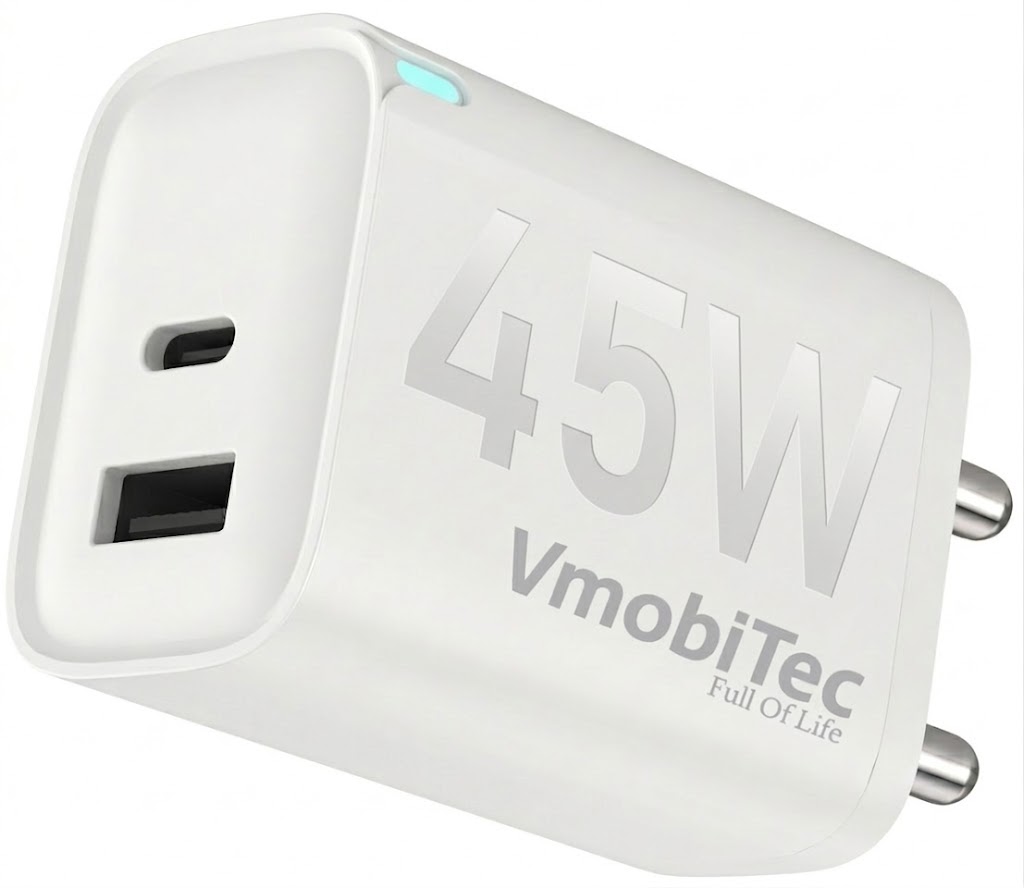
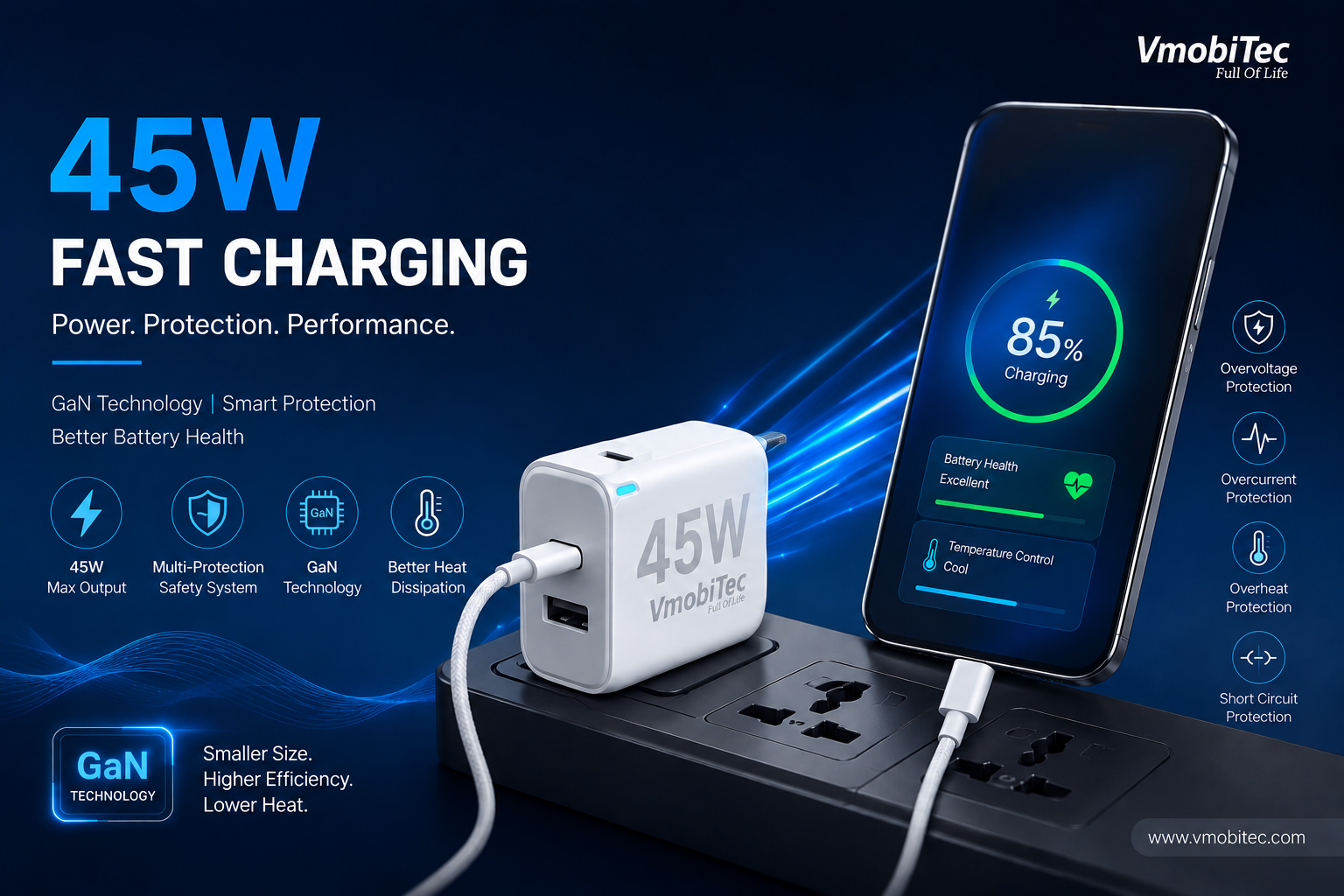
If you’ve searched “45W fast charging battery health,” you’re probably wondering whether speed comes at the cost of battery lifespan. It’s a fair question — not all fast chargers are built the same, and cheap ones absolutely can stress a battery over time. The good news: with proper thermal management and smart chip protection, like what Vmobitec built into its 45W GaN PD 3.0/QC 3.0 charger, 45W speeds are safe for daily use. Here’s what actually determines the outcome.
What Determines 45W Fast Charging Battery Health
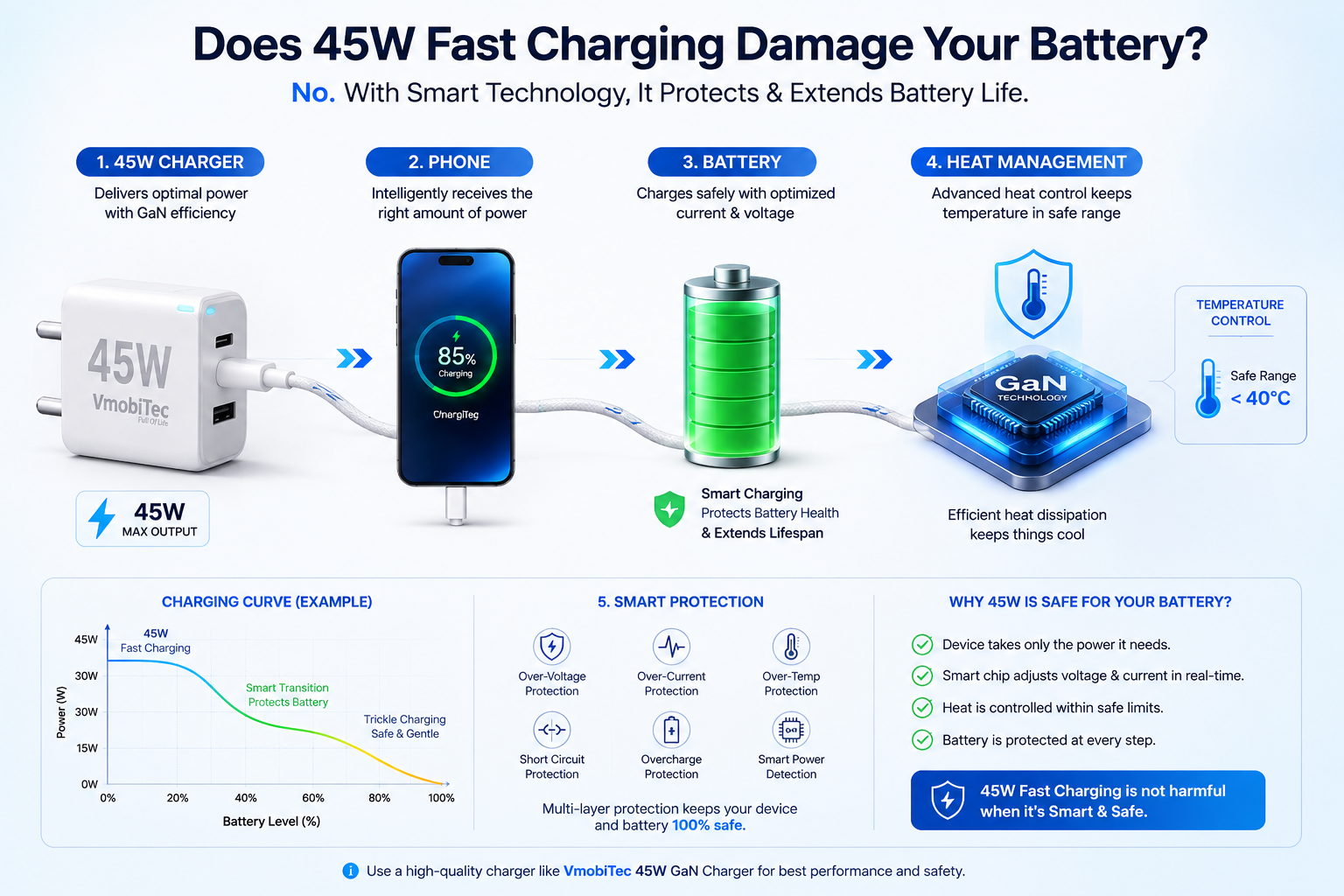
45W fast charging battery health depends less on wattage itself and more on how well a charger manages heat, voltage, and current delivery. A well-engineered 45W charger will actually be gentler on your battery than a cheap 20W charger with no regulation.
Lithium-ion batteries degrade from two main stressors: heat and voltage instability — not raw charging speed. A charger that ramps power intelligently and cuts back once a device nears full capacity avoids the conditions that actually shorten battery life.
This is where GaN (gallium nitride) technology changes the equation. GaN chips run cooler than traditional silicon chargers, which directly reduces the heat exposure your battery experiences during a charge cycle. Lower heat during charging is one of the single biggest factors in preserving long-term battery capacity.
Why Voltage Regulation Matters More Than Wattage
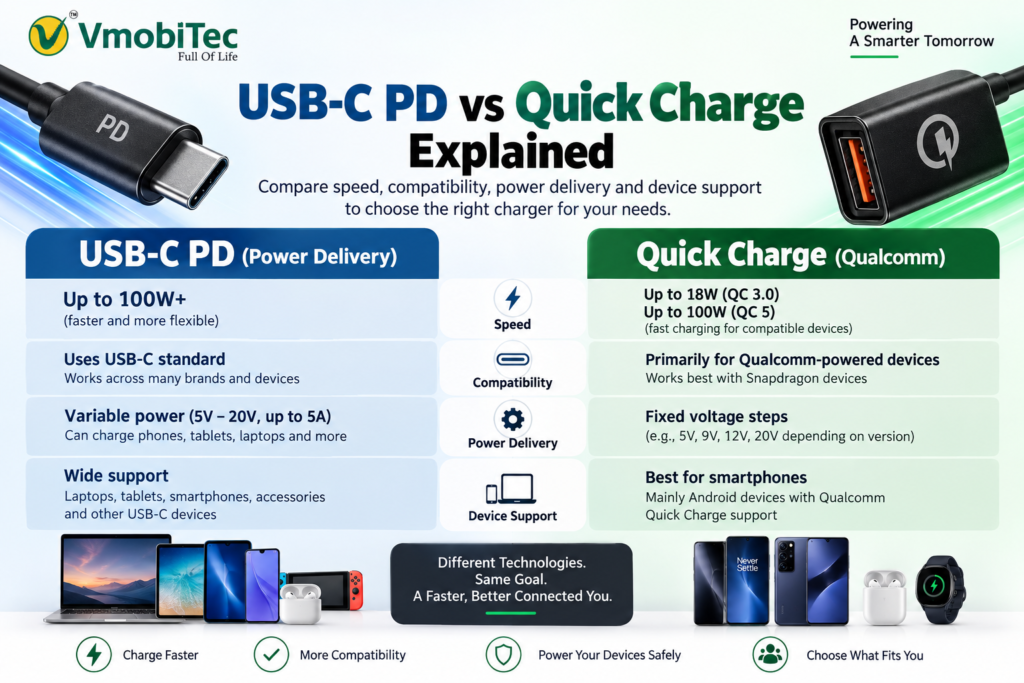
A 45W charger that delivers a clean, regulated voltage curve puts less strain on a battery than a lower-wattage charger with voltage spikes. PD 3.0 and QC 3.0 protocols exist specifically to negotiate the correct voltage with your device, rather than blasting a fixed output regardless of what the phone can handle.
Does 45W Charging Damage Battery Capacity?
No — 45W charging does not inherently damage battery capacity when the charger includes proper thermal and current controls. The myth that “fast charging always harms batteries” comes largely from older, unregulated fast chargers, not from the charging speed itself.
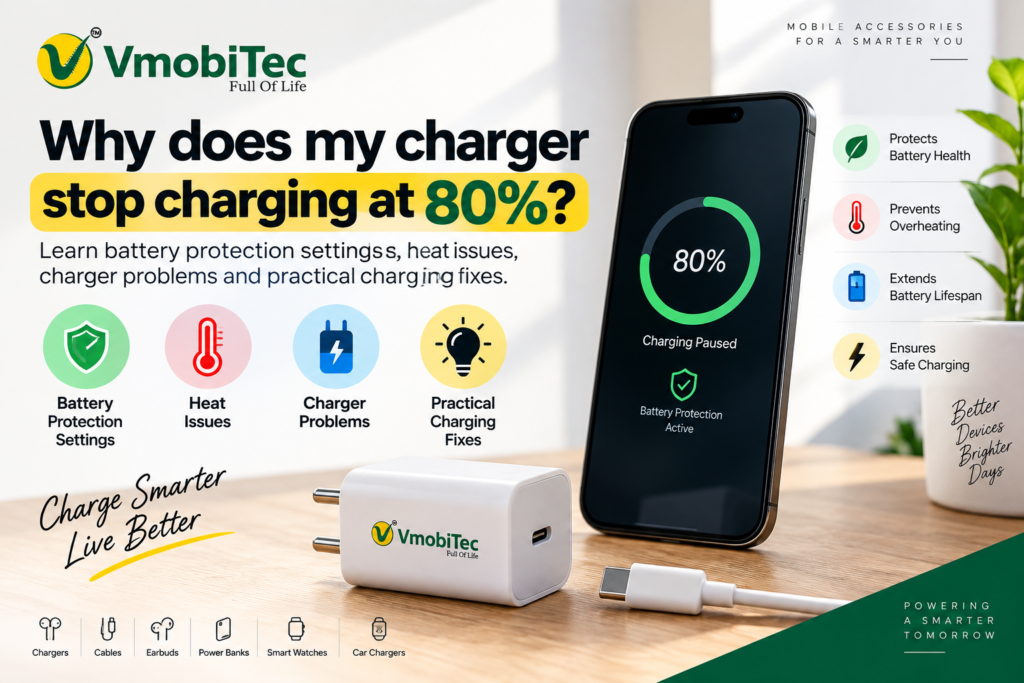
Modern smartphones are engineered with their own internal charge controllers that throttle incoming power once the battery hits roughly 80% capacity. This is why even a 45W-rated charger won’t blast constant high wattage into your phone for the full charge cycle — the phone itself manages the taper.
What actually causes degradation is heat buildup from poor-quality electronics, inconsistent voltage, or a charger lacking overcurrent and thermal protection. That’s the gap a smart chip closes.
How Vmobitec’s Smart Chip Protection Works
Vmobitec’s 45W charger uses smart chip protection to continuously monitor output and cut power the instant it detects overheating, overcurrent, or a short circuit. Combined with GaN’s naturally cooler operation, this keeps the battery in a stable temperature range throughout the charge — which is the real determinant of long-term battery health.
45W Charger Battery Life: Real-World Expectations
A quality 45W charger, used under normal conditions, has no measurable negative impact on your phone’s usable battery lifespan compared to a standard charger. Battery life is measured in charge cycles, and a full cycle happens regardless of whether it took 30 minutes or 3 hours.
In practice, engineers I’ve spoken with in the mobile accessories space consistently point to the same conclusion: it’s charger quality, not charging speed, that separates a battery that holds 90% capacity after two years from one that degrades to 70%.
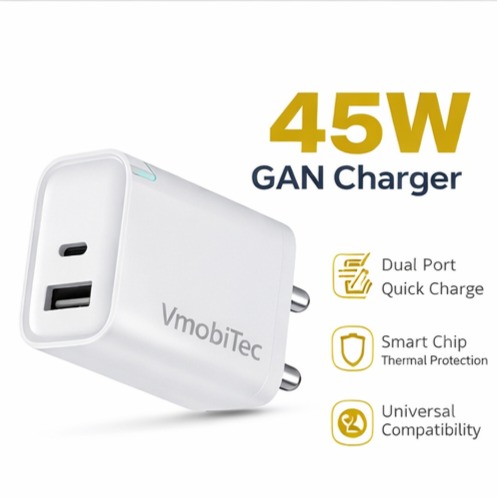
Dual-port charging, like the USB-C and USB-A setup on Vmobitec’s 45W unit, adds another layer of flexibility — letting you split power across two devices without forcing either one into an unregulated, single-port maximum draw.
GaN Technology, PD 3.0, and QC 3.0 — How They Work Together
| Feature | What It Does | Battery Health Impact |
|---|---|---|
| GaN Technology | Runs cooler and more efficiently than silicon | Reduces heat exposure during charging |
| PD 3.0 (Power Delivery) | Negotiates precise voltage/current with device | Prevents overvoltage stress |
| QC 3.0 (Quick Charge) | Adjusts output dynamically per device request | Avoids power spikes |
| Smart Chip Protection | Monitors current, voltage, temperature in real time | Cuts power before damage occurs |
| Thermal Safety System | Regulates internal charger temperature | Protects both charger and connected battery |
Together, these systems answer the core question behind “is 45W charging safe for smartphones” — the safety comes from the combination of protocols and protection, not from any single spec.
Key Benefits of Vmobitec’s 45W Fast Charger for Battery Health
- Dual-Port GaN Design: Charges two devices — phone and tablet, or phone and earbuds — simultaneously without overloading either port.
- PD 3.0 & QC 3.0 Compatibility: Automatically matches the correct charging protocol for iPhone, Samsung, Pixel, and most USB-C/USB-A devices.
- Smart Chip Protection: Actively prevents overcurrent, overvoltage, and short-circuit conditions that degrade battery cells.
- Thermal Safety System: Keeps operating temperature low, addressing the leading cause of long-term battery wear.
- Universal Compatibility: Works across phones, tablets, and other USB-powered devices without needing multiple chargers.
- Compact GaN Form Factor: Smaller and lighter than legacy silicon chargers, making it practical for daily carry and travel.
Frequently Asked Questions About 45W Fast Charging Battery Health
Q: Does 45W fast charging damage battery health?
A: Not when the charger includes proper voltage regulation and thermal protection. Vmobitec’s GaN charger with PD 3.0/QC 3.0 and smart chip safety keeps heat and voltage stable, which are the actual factors behind battery degradation — not the wattage itself.
Q: Is 45W fast charging bad for battery longevity?
A: No. Battery longevity is tied to charge cycles and heat exposure, not charging speed alone. A well-regulated 45W charger causes no more wear than a slower, unregulated one — and often less.
Q: Does a 45W charger reduce battery life over time?
A: A quality 45W charger with thermal safety and smart chip protection does not meaningfully reduce battery life. Poor-quality, unregulated chargers are the actual risk factor, regardless of their rated wattage.
Q: Is 45W charging safe for smartphones?
A: Yes, for the vast majority of modern smartphones. Devices negotiate their own safe charging curve via PD 3.0 or QC 3.0, and the phone’s internal controller manages the taper as it approaches full charge.
Q: Does 45W fast charging cause battery degradation?
A: Degradation comes primarily from sustained heat and voltage instability, not from 45W speeds specifically. GaN technology reduces heat output, which directly limits one of the two main degradation triggers.
Q: What makes a 45W charger battery health, part of my routine?
A: Look for GaN construction, PD 3.0/QC 3.0 protocol support, and smart chip thermal protection — the combination Vmobitec’s 45W charger uses to keep daily fast charging safe for long-term battery condition.
Final Verdict on 45W Fast Charging Battery Health
45W fast charging battery health comes down to engineering quality, not raw speed. A charger built with GaN technology, PD 3.0/QC 3.0 protocol support, and smart chip thermal protection — like Vmobitec’s dual-port 45W charger — keeps your battery in a safe temperature and voltage range through every charge cycle. If you’re choosing a fast charger, prioritize thermal safety and protocol compatibility over wattage alone, and daily fast charging won’t cost you battery lifespan.